
Curious about what fill power really means and why it matters for your down gear? Wondering how fill power, fill weight, and product construction combine to affect warmth, weight, and packability? Let’s unpack the essentials so you can make the best choice for your outdoor insulation needs.
In SHORT…
-
What exactly is fill power and how does it reflect down quality? Understand what those numbers really mean for loft and warmth.
-
How does fill weight impact the overall insulation and comfort? Learn why the amount of down inside is just as important as its fill power.
-
Why is the construction of down products critical? Discover how design influences insulation effectiveness and durability.
I imagine you’ve arrived on this page because you’re wondering, “what is fill power?”. You also looking to purchase a jacket, sleeping bag, or down-insulated product. You may have come across the term ‘fill power’, followed by a seemingly arbitrary number. We’re here to explain what this number represents. Additionally, we explain why you should be paying attention to it before purchasing your new shiny piece of kit.
What is fill power?
It is a standard measurement of the quality of down insulation and references how well that down will resist compression and retain expansion, or ‘loft’. The higher the number the greater the loft. The greater the loft, the higher the quality, basically. That is a hugely simplified, ultra-quick answer for those that just popped over here for that info. It’s worth reading on, though, as the below will explain what the specific numbers mean and how they’re calculated.
What is down?
Natural down is made up of super lightweight and fluffy little clusters of, what are essentially, superfine feathers. Each down cluster is made up of plumules which are like hairy little arms. All those fine little plumules trap the warm air that a body produces. The finer the clusters and the finer the plumules, the more air will be trapped. Down only works when it is able to expand, or ‘loft’. All those little plumules need to be able to waft around and trap the warm air; if they’re compressed (or wet) they are far less effective.
The Science Behind Fill Power
‘Fill power’ is represented by a number; usually 500, 600, 700 and so on.
The highest we’ve seen is 1000 fill power.
These numbers represent how much volume 1oz (or 28.4g) of down will expand, or loft, into.
The amount of volume is indicated by those numbers, so 500 = 500 cubic inches.
There are two tests that measure fill power: the European and the US tests.
In the UK we have widely adopted the US test and for simplicity, I’ll stick with that one too.
The test itself involves placing precisely 1oz (28.4g) of conditioned down in a cylinder that is 290mm in diameter x 500mm in height. The down is then compressed from above with a flat object, or plate mass, weighing 3.3245709 oz (94.25g). The down volume is then measured and assigned a corresponding fill power.
And that’s about it really. The higher the number, the greater the loft and this also indicates the quality of the clusters. Only the finest, fluffiest, lightest clusters will produce those high numbers. So, you may be thinking that a 1000-fill power jacket will obviously be warmer than a 500-fill power jacket. That’d be too simple…
The higher the fill wait the warmer it will be
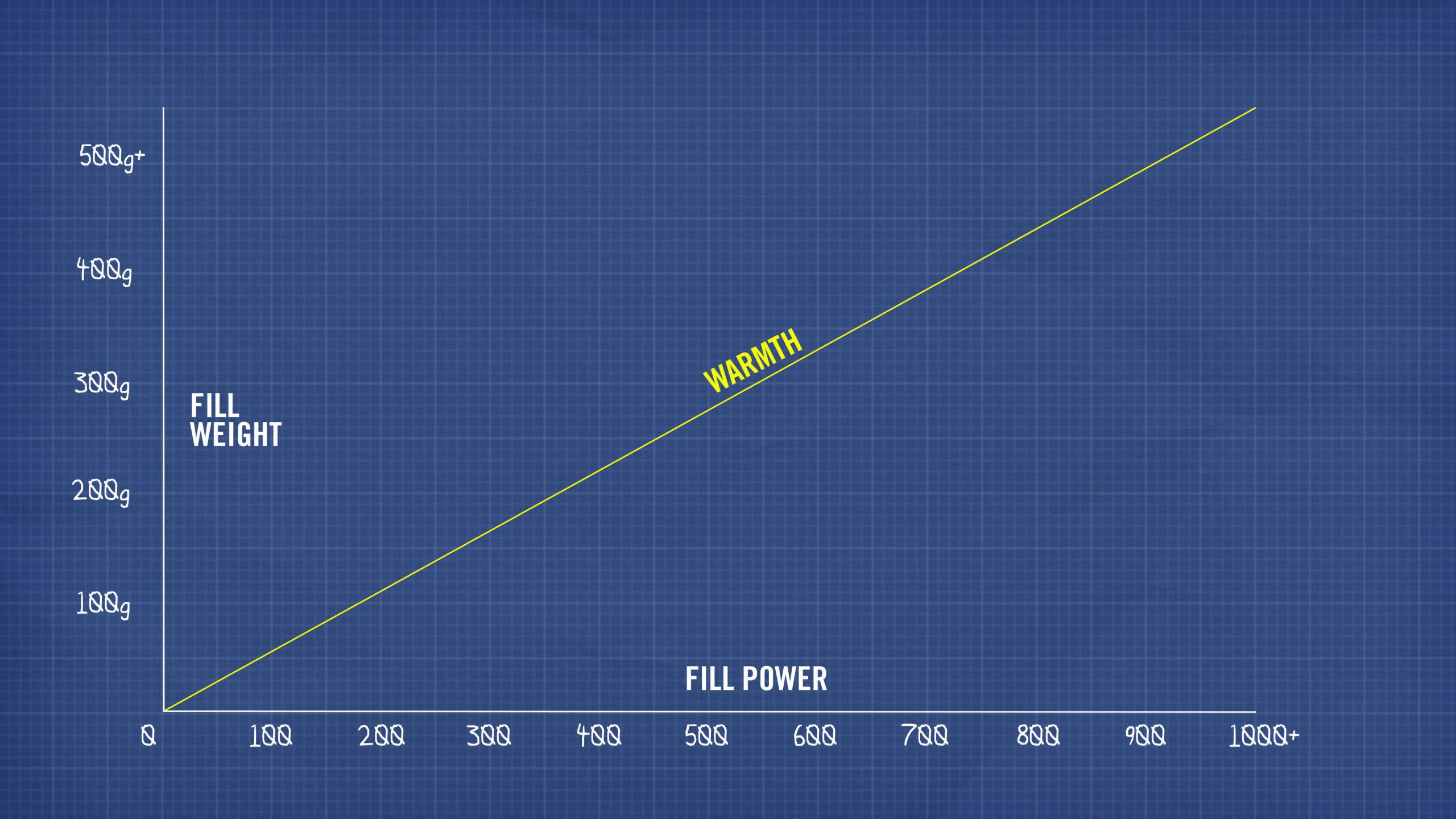
Fill power indicates the quality, but the physical amount of the down in the garment will play just as big a role. This is usually referred to as ‘fill weight’. Fill weight is defined by the total amount of down placed in a product. It is usually measured in grams. Very generally speaking, the higher the fill weight of a product, the warmer it will be.
Baffles: The Art and Science of Down Product Construction
Construction of the product is also just as important because, down needs to ‘loft’ to be effective. It needs empty space to expand into freely. A badly constructed product will have baffles (structures that contain the down) that restrict the down and make it less effective. The construction of the baffles in a product is a mixture of art and science. It is a subject much too big to cover here. – We have a team of experts who carefully inspect all our products. Our experts wear lab coats and use pencils to scrutinize every detail. They pay attention to every aspect of the product, including the size of the baffles and amount of down. They ensure that the down is not restricted, making the product more effective. You can trust that we only stock well-constructed products.
A Real-Life Comparison
We would like to conclude with a real-life example. A 1000 fill power jacket with 150g of down in stitch through baffles will, theoretically, offer the same warmth as a 500 fill power jacket with 300g of down in stitch through baffles. The 1000 fill power jacket will be much lighter and will compress down far smaller. That’s because it requires less down to achieve the same warmth, but consequently might cost twice as much. The 500 fill power jacket will be heavier and bulkier, but will offer more ‘cosiness’ and will cost significantly less.
As always, the trick is to get the product that suits your intended use. If you’re a weight-conscious alpinist who needs the absolute pinnacle of performance for the least weight and pack size. You should be looking for products with a high fill power and a low fill weight. But if you’re just an everyday hill plodder, you’ll be just fine with a mid-level fill power and sensible fill weight.
Are you curious about the differences between softshells and hardshells? Learn from the experts and make the most of your outdoor gear.
Leave a Reply