
How to Choose Walking Poles

Author: Trekitt Gear Team
Outdoor gear specialists who spend a lot of time walking up (and more importantly down) UK hills in all sorts of weather. From lightweight folding poles to tough aluminium trekking poles, we test what helps with stability, comfort and tired knees
Two legs are good—but four? Even better. If you’re wondering how to choose walking poles without getting tangled in techy jargon or endless options, you’re in the right place. We’ll make sense of all the specs so you can stride, climb, and cruise with confidence.
In SHORT…
- How walking poles protect your joints, improve balance, and help you walk with better posture
- When and why to use different tip types, baskets, or shock absorption system.
- What features actually matter when choosing the right poles for your terrain and goals
Why even bother with walking poles in the first place?
Walking poles might seem like something only seasoned hikers or your hill-walking uncle would use, but hear us out. Once you give them a go, you’ll wonder how you ever managed without them. They’re not just for big mountain days or dodgy knees; poles can make any walk feel smoother, more stable, and less tiring.
Do my joints really need backup?
Honestly? Yes, especially if you walk long distances or hit steep, rocky ground. Every step on a descent puts serious pressure on your knees, ankles, and hips. Poles help to absorb some of that impact, reducing the wear and tear on your joints over time.
Think of it as spreading the load. Instead of every downhill thump being absorbed by your legs alone, the poles help take the edge off. You’ll feel the difference on long descents, rough terrain, or when carrying a heavy pack.
Will I actually walk straighter?
It’s not just your legs that benefit. Walking with poles encourages better overall posture and balance, especially if you have a rucksack. When your upper body is engaged, you naturally walk taller, keep your shoulders back, and avoid that tired slouch hikers sometimes fall into by hour five.
They also act as stabilisers. Crossing a stream, hopping across scree, or tackling a muddy hill? Poles give you two extra contact points with the ground, meaning fewer slips, fewer awkward recoveries, and less twisting through your knees and hips.
Fatigue‑buster or just extra faff?
Fair question, because yes, poles are extra gear. But in exchange for a few hundred grams, you gain a noticeable boost in efficiency. Walking poles help spread the effort across your whole body. Your arms join the workload, taking some of the strain off your legs and relieving tired quads.
And there’s a rhythm to it. That steady pole‑planting pace helps you find a walking groove, keeps your breathing more regular, and prevents those tired, clumsy steps near the end of a hike. Moreover, they give your hands something to do, which can help reduce swelling during long treks.
Real-world wins (trail tales from the Trekitt crew)
We’ve seen it first-hand, countless times.
- Camino de Santiago pilgrimage: One user emailed us from Spain to say poles were “life-saving” for long days on tarmac and gravel tracks. They helped with rhythm, posture, and avoiding blisters by reducing pressure on their feet.
- West Highland Way, day 5: Two customers rented poles halfway through. One said they felt “reborn.” The other said they finally understood why people swear by them.
- Family strolls in the Brecon Beacons: Mum used them for balance. Her kids turned them into sword-fighting props. Everyone walked further than planned.
The short version? They work. And not just on epic multi-day treks but on everyday walks, too.
Quick take‑aways
- Protect your joints: especially helpful on descents or with heavy packs
- Improve your balance and posture: walk taller, wobble less
- Save energy: share the load with your arms
- Use them beyond walking: stream crossings, tent pitching, wild photography setups
Want to dive deeper? Check out our full blog on why walking poles are so useful—we break down the real benefits, when to use them, and tips from our own time on the trail.
How to choose walking poles: Pole Anatomy
Not all walking poles are the same, but most share the same basic components. Understanding each part can help you choose the right pole for your walking style, terrain, and preferences.
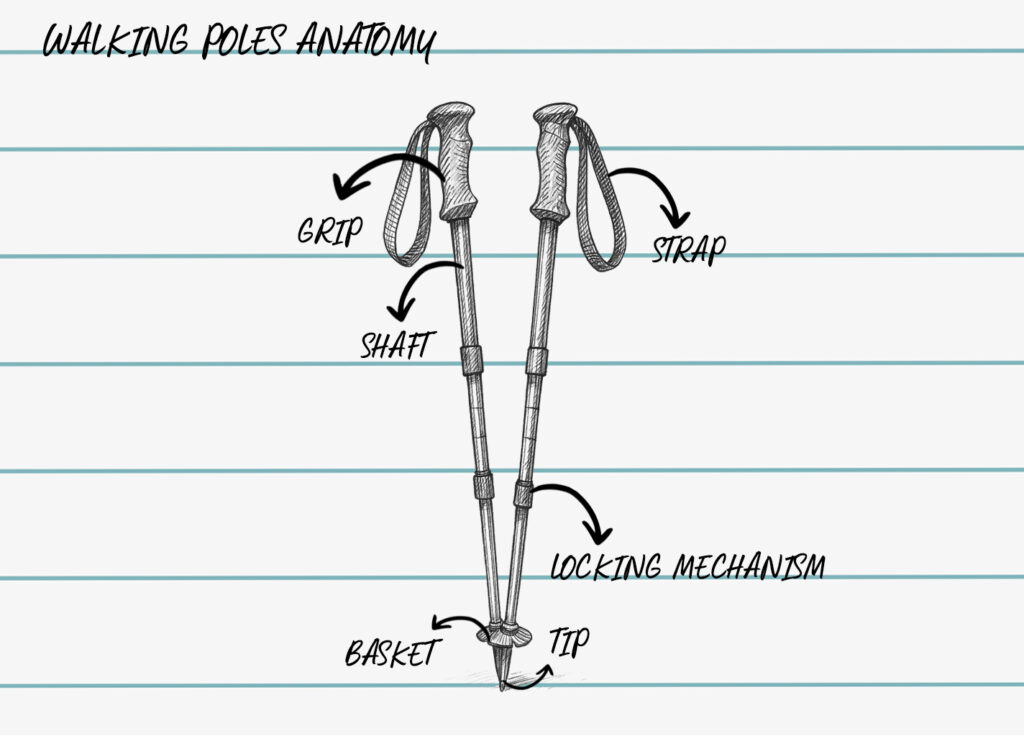
Grip (a.k.a. handle)
The bit your hand wraps around.
Grips come in different materials: cork, EVA foam, or rubber, and each has its perks:
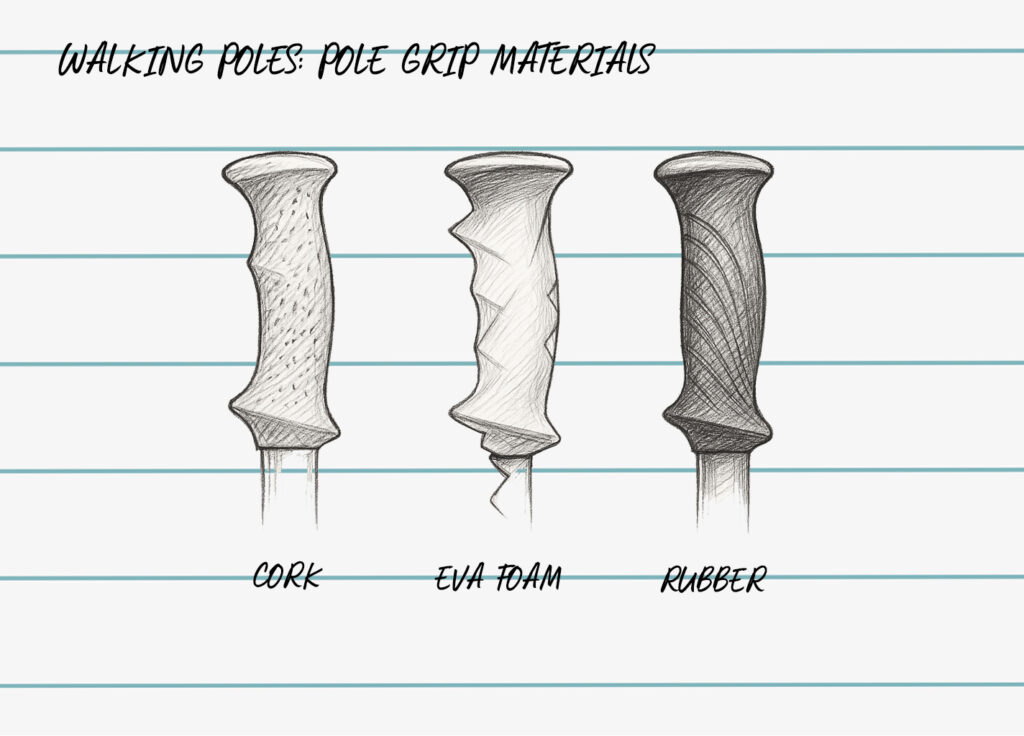
- Cork: Breathable and moulds to your hand over time. Great for sweaty hands and warmer climates.
- EVA foam: Lightweight and comfy. Slightly softer feel, suitable for casual or cooler-weather walks.
- Rubber: Best for cold, wet conditions, but can get slippery if your hands sweat a lot.
Look out for extended grips, which let you quickly adjust hand position when climbing without shortening your poles.
Straps
They’re not just there to keep you attached to the pole. When used correctly, they help transfer force from your arm to the pole without gripping too tightly.
Look for adjustable, padded straps that won’t chafe over long distances. Some high-end models come with ergonomic strap systems or glove-style inserts.
Shaft
It is the main body of the pole. Most popular types are:
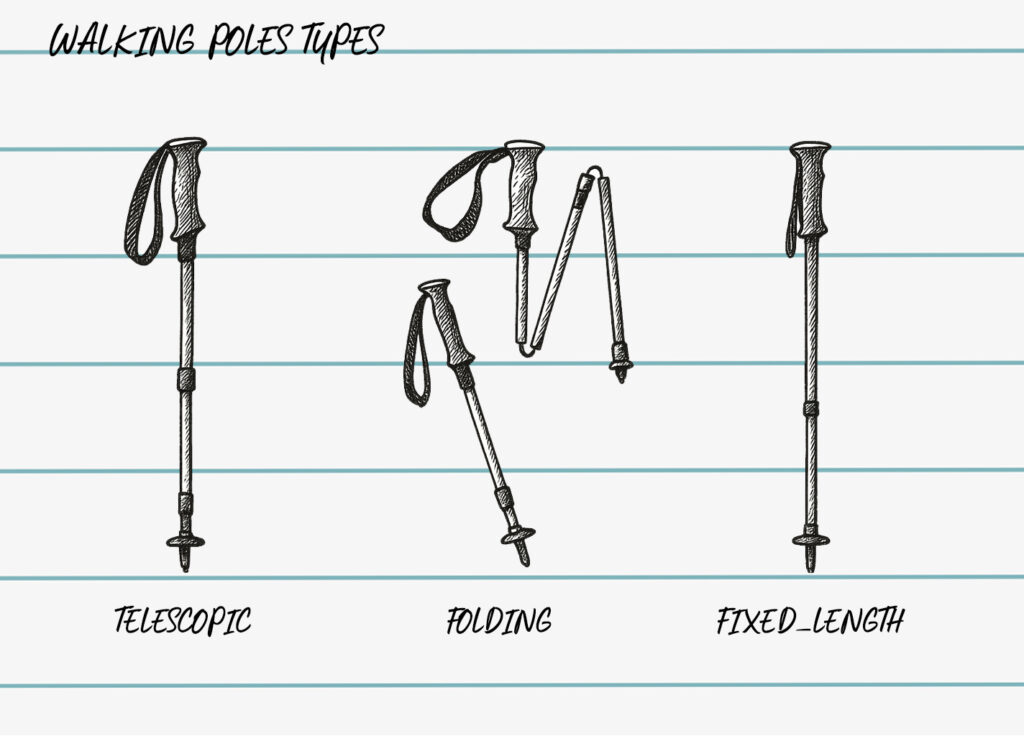
- Telescopic (slide in/out to adjust height)
- Folding/Z-style (great for compact packing)
- Or fixed-length (lightweight and strong, but less versatile)
Made from aluminium (tougher, slightly heavier) or carbon fibre (lighter, more expensive, slightly less durable).
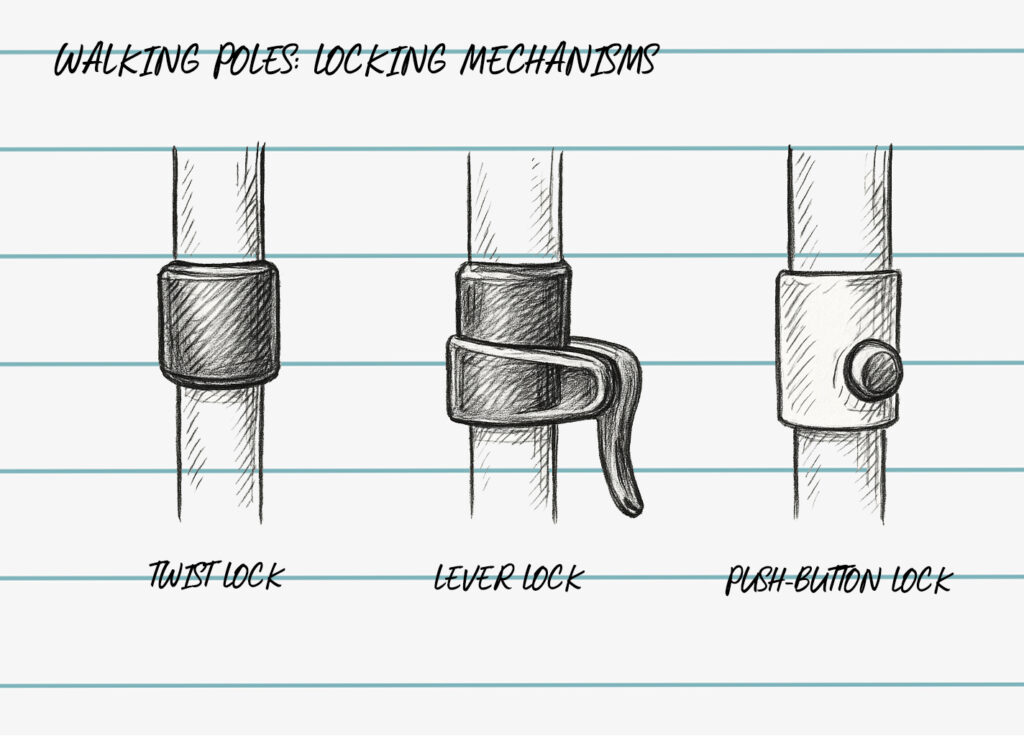
Locking Mechanism
It is how the pole stays at your chosen length. There are three main types:
- Twist locks – older style, lighter but more fiddly
- Lever (flick) locks – quick and easy, reliable in cold/wet weather
- Push-button locks – often found on folding poles; snap into place with one press
Basket
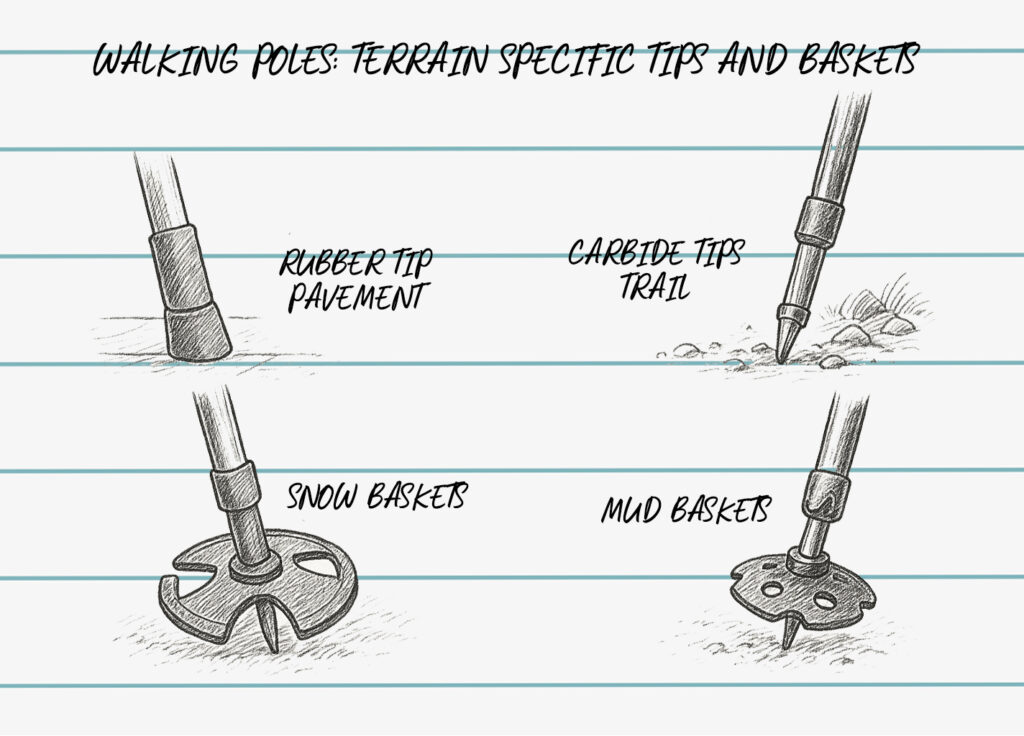
The little disc near the tip prevents your pole from sinking too deeply into soft ground.
- Trekking baskets – standard, suitable for most trails
- Snow baskets – wider, designed for winter or boggy ground
- Mud baskets – somewhere in between!
Bonus tip: baskets are usually interchangeable, so that you can swap them depending on the season.
Tip
The business end. Most poles have:
- Carbide tip – super grippy and durable, ideal for rocky or loose terrain
- Rubber tip – slides over the carbide for pavements or indoor use
- Boot tip – angled rubber, great for road walking or urban trekking
2. Are all walking poles the same? What are the different types?
At first glance, walking poles might all look pretty similar—stick, handle, pointy end—but there’s more going on. From how they fold to what kind of walking they’re made for, picking the right type can make a big difference in comfort and performance.
Let’s break it down.
Telescopic Poles
These are the most common type and a solid all-rounder. The pole comprises two or three sections that slide inside each other, and you adjust the height using a locking mechanism (usually twist or lever locks).
Great for:
- Hikers who want adjustability
- Sharing poles between people
- Adjusting length for uphills/downhills
Pros:
- Height adjustable on the fly
- Can collapse small enough to strap to your pack
- Strong and stable
Cons:
- Slightly heavier than folding poles
- More moving parts to maintain
Folding (Z-Style) Poles
These poles fold down like tent poles, often into three short segments connected by an internal cord. They’re super compact and lightweight—ideal for fast and light adventures.
Great for:
- Trail runners
- Fastpackers
- Travellers with limited pack space
Pros:
- Tiny packed size
- Lightweight
- Quick to deploy (on some models)
Cons:
- Usually not height adjustable (some are)
- Less robust than telescopic designs
- Fixed length makes sharing harder
Fixed-Length Poles
What you see is what you get. These poles are one solid piece—no folding, no adjusting. They’re rare for trekking but more common in Nordic walking.
Great for:
- Activities where ultralight matters most
- People who know their perfect length
- Nordic walking
Pros:
- Strongest and lightest option
- No parts to fail
- Super simple to use
Cons:
- Can’t adjust height
- Tricky to transport or store
- Not versatile for varied terrain
Which walking poles should you choose?
If you’re unsure which type of walking pole is right for you, this quick guide makes it easier to decide.
Choose telescopic poles if:
- You walk varied terrain
- You adjust pole length regularly for climbs and descents
- You share poles with someone else
- You want the most versatile option for UK hillwalking
Telescopic poles are the most adaptable choice and suit most walkers.
Choose folding (Z-style) poles if:
- You fastpack or move quickly on the trail
- Packed size matters
- You regularly carry poles in your backpack
- You travel with poles
Folding poles are compact, lightweight, and ideal when space is limited.
Choose fixed-length poles if:
- You mainly Nordic walk
- You prioritise the lightest possible setup
- You already know your ideal pole length
Fixed-length poles are simple and efficient, but less flexible for mixed terrain.
How to choose walking poles: Nordic Walking Poles vs Trekking Poles
While they might look similar, Nordic walking poles and trekking poles are built for very different things.
Nordic Walking Poles
Nordic walking poles are best for fitness walking on flat or gently undulating ground. They’re usually fixed or semi-fixed in length and come with special gloves or straps to allow efficient pole planting and release.
- Lightweight and springy
- Rubber boot tips for pavement use
- Used with a fast, swinging arm motion (not for steep hills or off-road use)
Trekking Poles
Made for the hills, mountains, and trails. These are usually telescopic or folding, with carbide tips for grip on mixed terrain and optional baskets for mud or snow.
- Designed for load support and balance
- Durable for rough trails
- Often adjustable in length
Which one’s right for you?
Ask yourself:
- Do you need poles to pack small or just clip to your rucksack?
- Will you be hiking varied terrain or mostly on pavement?
- Do you prefer something ultralight, or are you happy with a bit more weight for stability?
No pole does it all, but the right one can make every step feel easier. If you’re still not sure, pop into our shop or try renting a pair of trekking poles from trekitt first to see what best suits your walking style.
3. What should I look for in the pole material?
It’s easy to overlook, but the material your poles are made from plays a big role in how they feel on the trail, especially over long distances. The two main options you’ll come across are aluminium and carbon fibre, and each has its own set of pros, cons, and price tags.
Let’s break it down so you can pick what’s right for you.
Aluminium Poles
The trusty workhorse of the walking pole world. Aluminium poles are strong, durable, and budget-friendly, often the go-to for beginner and intermediate hikers.
Great for:
- Beginners
- All-round trekking
- Rough terrain and colder weather
Pros:
- Tough and bend-resistant (they’ll usually bend before they break)
- Affordable
- Handle knocks and scrapes well
Cons:
- Heavier than carbon poles
- Can vibrate a bit more on hard ground
- Slightly bulkier when packed
Carbon Fibre Poles
These are the lightweight flyers. Carbon poles are often chosen by trail runners, thru-hikers, and gram-counters who want to move fast and carry less.
Great for:
- Long-distance walkers
- Trail runners and fastpackers
- Hikers who value ultralight gear
Pros:
- Extremely lightweight
- Absorbs shock better than aluminium (less vibration)
- Feels smoother on long hikes
Cons:
- More expensive
- Can crack or splinter under high stress (e.g. if jammed between rocks)
- Less forgiving than aluminium if overloaded
So, which should I choose?
Here’s the quick take:
| Material | Best For | Weight | Durability | Price |
| Aluminium | Everyday hikers, beginners | Heavier | Very durable | Budget-friendly |
| Carbon Fibre | Distance hikers, lightweight lovers | Lighter | Less impact-resistant | Higher-end |
Still unsure? You can always test both types through our Trekitt rental service to see what feels best on your adventures.
How to choose durable walking poles
If durability is your priority, especially for regular UK hillwalking or winter use, there are a few features worth looking for.
Choose aluminium shafts rather than carbon
Aluminium poles are generally more resistant to knocks against rock and cope better if a pole gets trapped between stones or underfoot. Carbon poles are lighter, but aluminium is usually the safer choice for rough terrain and colder conditions.
Look for flick-lock adjustment systems
Flick locks are reliable, easy to adjust with gloves on, and tend to hold their length better over time than twist-lock systems, particularly in wet or muddy conditions.
Check for replaceable pole tips
Walking pole tips naturally wear down with use on rocky paths. Replaceable tips extend the life of your poles and help maintain grip on hard surfaces.
Choose poles with stronger lower shaft sections
The lower section of a walking pole takes the most impact while you’re moving. Slightly thicker or reinforced lower shafts improve long-term durability, especially on uneven ground.
Together, these features make a noticeable difference if you regularly walk on rocky trails, carry heavier packs or head out in winter conditions.
Best walking poles for different activities
Different walking styles benefit from different pole designs. Here’s a quick guide to what works best.
Hillwalking
→ aluminium telescopic poles
Aluminium poles are strong, reliable and handle rough UK terrain well. Telescopic adjustment makes them ideal for changing gradients throughout the day.
Winter walking
→ aluminium poles with snow baskets
Aluminium performs better than carbon in freezing conditions and is more resistant to impacts on rocky ground. Snow baskets improve stability on soft surfaces and prevent poles from sinking too deeply.
Trail running
→ carbon folding poles
Carbon poles reduce weight and vibration while folding designs pack small when not in use. Ideal for fast-moving mountain days and races.
Travel walking
→ compact folding poles
Folding poles pack down small enough to fit easily inside luggage or attach neatly to a backpack when not needed.
Best walking poles for UK trails
For most UK hillwalking routes, aluminium telescopic walking poles are the most practical choice. They handle rocky paths, wet ground and uneven terrain well, and the adjustable length makes it easy to shorten poles for climbs and lengthen them again on descents.
They’re also more forgiving if a pole gets trapped between stones or caught on rough ground, which is something that happens surprisingly often on British trails.
Reliable examples include:
Black Diamond Alpine Carbon Cork
These types of poles offer the best balance of durability, adjustment and all-day comfort across typical UK routes in places like the Lake District, Snowdonia and the Scottish Highlands.
4. How do I know what pole length is right for me?
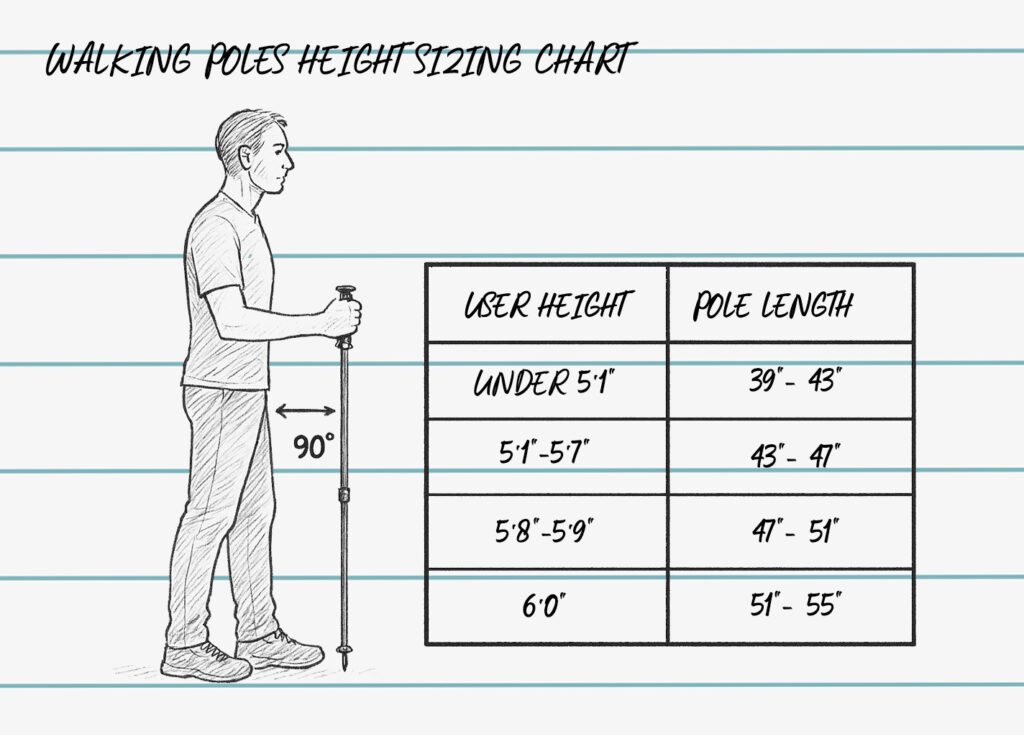
Getting the right pole length isn’t about comfort only. It affects your posture, balance, and how efficiently you move. Too long and you’ll be reaching awkwardly. Too short and you’ll hunch over. The sweet spot? A 90° bend at the elbow when the pole tip touches the ground.
Here’s how to find it.
How to choose walking poles: General height-to-pole-length guide
If your poles are adjustable, you’ll want to set them based on height. Fixed or folding poles? Use the guide below to find the best match:
How to adjust poles for uphill and downhill
One of the big perks of telescopic poles is the ability to tweak length depending on terrain. Here’s what to do:
Uphill:
- Shorten your poles by 5–10 cm. This gives you better leverage and keeps your arms in a comfortable position when the ground rises steeply.
Downhill: - Lengthen your poles by 5–10 cm. It helps with stability and reduces impact on your knees by allowing you to reach ahead for support.
Traversing a slope: - Shorten the uphill pole, lengthen the downhill one, and keep your shoulders level.
Quick at-home measurement method
No tape measure? No problem.
- Put on your usual walking shoes or boots.
- Hold a walking pole (or even a broomstick) vertically with the tip on the ground.
- Adjust the height until your elbow is at a 90° angle and your forearm is parallel to the ground.
- Measure the pole length from floor to grip—that’s your baseline.
Write that number down—it’s your go-to starting point for most terrain.
5. What kind of grip feels best, and does it even matter?
You bet it does. The grip is your main connection to the pole, so getting the right feel can make a big difference in comfort, especially over long days or back-to-back hikes. Sweaty hands, cold fingers, or achy wrists? The wrong grip can ruin a good walk.
Let’s look at the main grip types and what suits who.
Cork Grips – breathable and form-fitting
Cork is a natural material that moulds to your hands over time, making it more comfortable the more you use it. It also wicks away moisture, making it great for sweaty hands or hot climates.
Pros:
- Breathable and moisture-wicking
- Moulds to your grip over time
- Light and slightly shock-absorbing
- Feels warm in cooler weather
Best for: Long-distance treks, sweaty hands, varied weather
EVA Foam Grips – soft and lightweight
Foam grips are light, comfortable, and budget-friendly. They don’t mould quite like cork but offer good cushioning and insulation. Foam is great if you’re walking in colder temps or wearing gloves.
Pros:
- Lightweight and soft
- Absorbs shock well
- Warm to hold (good for cold weather)
- Usually cheaper
Best for: Beginners, cold conditions, shorter hikes, glove users
Rubber Grips – tough and durable
Rubber grips are solid and long-lasting, providing excellent insulation in cold and wet weather. However, they’re not as breathable, so if your hands get sweaty, they might feel sticky or slippery.
Pros:
- Durable and weather-resistant
- Great insulation in cold/wet conditions
- Excellent for winter or mountaineering gloves
Cons:
- It can get slippery with sweat
- Less forgiving on bare hands
- Not breathable
Best for: Winter hikes, alpine trekking, wet weather with gloves
What about ergonomics and comfort?
It’s not just about material; shape matters too.
Look for grips that:
- Fit naturally into your hand (without forcing your wrist to bend)
- Have a slight forward angle or ergonomic design to reduce wrist strain
- Offer extended grip zones (especially helpful on steep ascents when you want to choke up on the pole)
Remember the strap system, padded, adjustable straps help spread the pressure across your wrist and palm so you don’t over-gripping the handle.
So, which grip is right for you?
| Grip Type | Best For | Not Ideal If… |
| Cork | Hot days, sweaty hands, long hikes | You’re on a tight budget |
| EVA Foam | Cold weather, casual hikes, glove use | You want a customised grip feel |
| Rubber | Winter or wet walks with gloves | You tend to sweat a lot/hike bare-handed |
6. Should I go for poles with shock absorption?
You’ll often see walking poles advertised with built-in shock absorbers, usually called anti-shock systems. It sounds great, right? But do you really need it? Or is it just more weight and marketing?
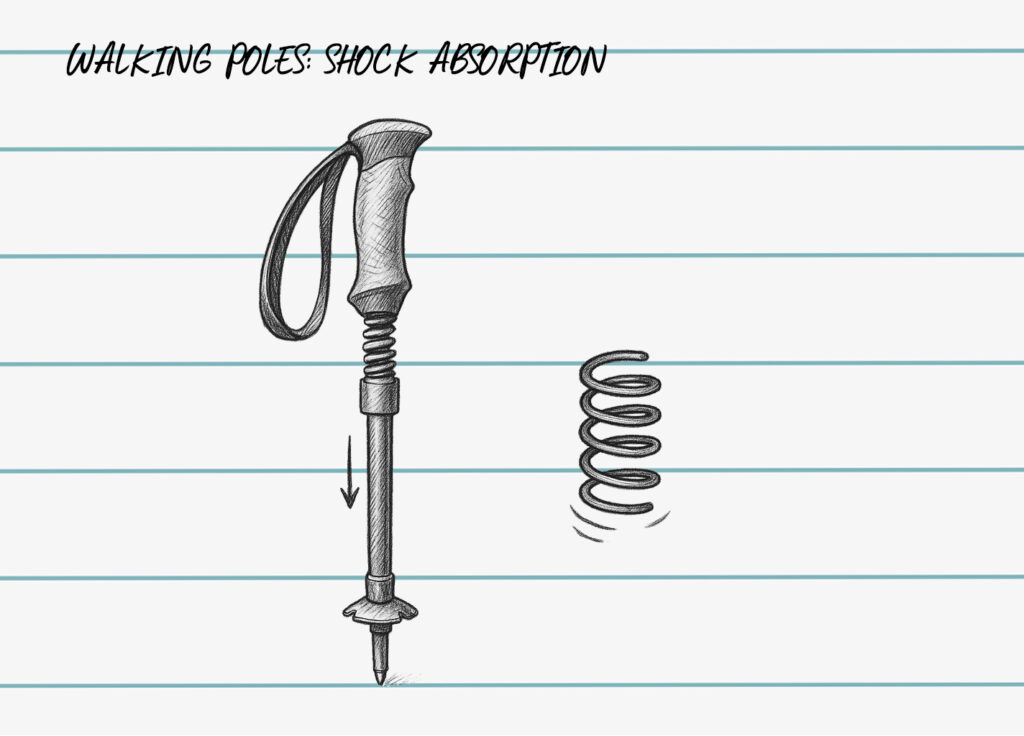
How do anti-shock systems work?
Shock-absorbing poles typically have a spring mechanism built into the shaft, just below the grip. When you plant the pole down, especially on hard surfaces, the spring compresses slightly, cushioning the impact before it travels up into your wrists, elbows, and shoulders.
Some poles let you turn the system on or off, depending on the terrain, which is a nice bonus.
When do you actually need it?
Anti-shock poles can be a game-changer for some users, but unnecessary for others.
You’ll benefit most if you:
- Struggle with joint or wrist pain
- Do a lot of downhill hiking on hard-packed trails
- Are carrying a heavy pack
- Prefer a smoother, softer pole-plant feel
But if you’re:
- Trail running
- Moving fast and light
- Mainly walking on soft ground
Then, shock absorption may just add weight and be less responsive.
Also, shock systems can slightly reduce power transfer, especially when pushing off uphill. If you rely on your poles for propulsion or speed, that little bit of give might feel more like mush.
Recommendations by terrain:
| Terrain / Use | Shock Absorption? |
| Rocky tracks & hard ground | Yes – protects wrists & joints |
| Soft trails or grassy paths | Not necessary |
| Steep downhills | Helpful for reducing impact |
| Uphill climbs | Might feel a bit too soft |
| Fastpacking/trail running | Skip it – extra weight |
| Long-distance treks | Worth it for all-day comfort |
7. Do I really need wrist straps and how do you use them correctly?
It’s one of those features you don’t think twice about—until your hands start cramping halfway through a hike. While they might seem like a minor detail, wrist straps can make a big difference to how comfortable and efficient your pole use is. Used the right way, they let you move better, rest your hands, and keep going for longer.
Strap design differences
Not all straps are equal. Most walking poles come with simple adjustable straps, but some high-end models offer padded, ergonomic, or even glove-style designs (especially on Nordic walking poles).
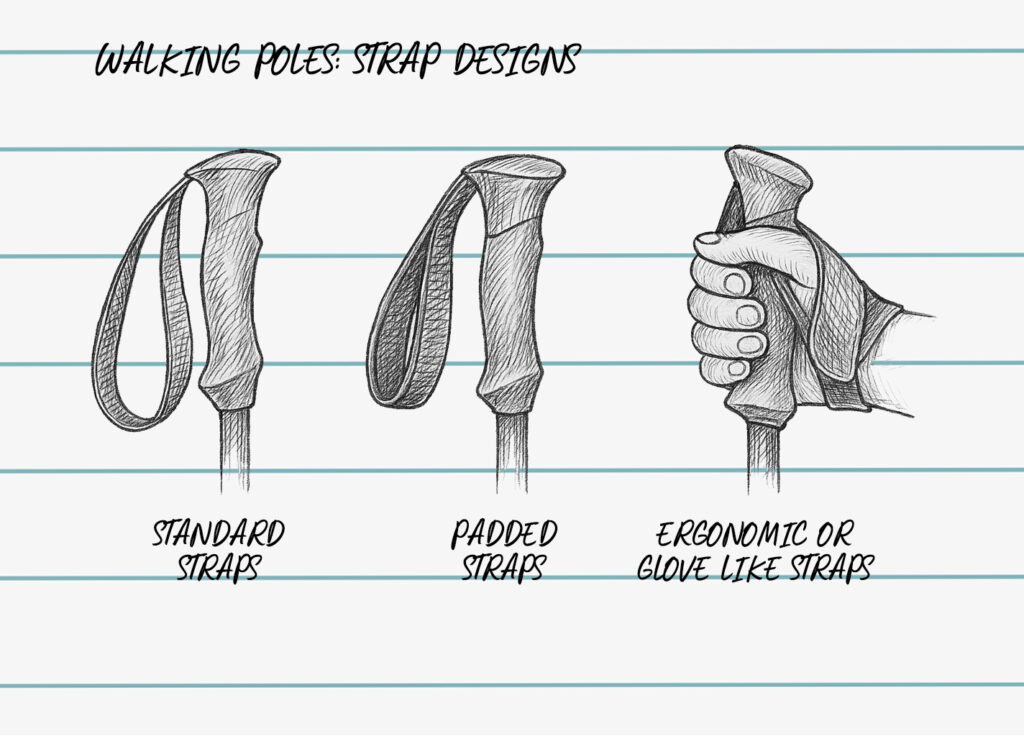
Here’s a quick breakdown:
- Standard straps: Webbing loops—adjustable, basic, gets the job done
- Padded straps: More comfortable on long walks or bare hands
- Ergonomic or glove-style straps: Used on Nordic poles, designed for precise movement and quick release
If you’re trekking for hours, comfort matters, so look for a soft or lined strap that won’t dig into your wrist.
How to use wrist straps properly (yes, there’s a technique)
Most people grab the strap over their hand. But the correct method is:
- The hand comes up from underneath the loop
- Let the strap sit across the back of your wrist
- Grip the pole with your hand gently over the strap
This way, the strap carries the load, not your fingers. It lets you push off using your wrist rather than clenching the grip all day, which massively reduces hand fatigue on longer walks.
Your grip should be relaxed. Let the strap do the work, especially on flatter terrain where poles are just helping you move rhythmically.
When to remove the strap (yes, sometimes you should)
There are times when it’s safer to not use the strap:
- Steep descents or scrambling – If you fall and your hand is trapped in the strap, the pole could twist or injure your wrist.
- River crossings – You want to be able to let go quickly if you slip or stumble.
- In dense forest or brush, Straps can catch on branches or obstacles.
If you’re heading into any of the above, slipping your hands out of the straps is smart until you’re back on safe, stable ground.
8. What are the best walking pole tips for different terrain?
It’s easy to focus on handles, locks, or materials, but the tips of your walking poles are what meet the ground. Choosing the right ones (and knowing when to use baskets) can give you a better grip, more control, and a longer life for your poles.
Let’s walk through the main options.
Carbide Tips – sharp and grippy
These are the default on most trekking poles. Tough, pointed, and built for the outdoors, carbide tips are ideal for gripping into hard-packed trails, rock, gravel, or ice.
Best for:
- Mountain trails
- Uneven, rocky terrain
- Slippery surfaces where grip is crucial
Watch out for:
- Scratching surfaces like pavements or indoors
- The sharp end—keep tip protectors on when not in use!
Rubber Tips – soft, quiet, and road-friendly
Rubber tips either slide over your carbide tips or screw in (depending on the model). They reduce noise and wear, and are ideal for harder, smoother surfaces like roads or stone tracks.
Best for:
- Pavement, tarmac, boardwalks
- Travel or urban walking
- Reducing wear on indoor or fragile terrain
Top tip: Keep a pair of rubber tips in your pack—they’re light and easy to pop on when needed.
Boot Tips – angled for better ground contact
Rubber “boot” tips have a slanted, shoe-like shape. They’re popular for Nordic walking and road use, giving more surface contact and a natural angle during fast strides.
Best for:
- Nordic walking
- Fast-paced walking on flat ground
- Reducing jarring on elbows and shoulders
When to use baskets or ditch them entirely
Baskets sit just above the tip and stop your poles from sinking too deeply into soft ground. Most poles come with trekking baskets, but you can swap them depending on the season.
- Trekking baskets (standard): Good for dirt trails, gravel paths, and moderate mud.
- Mud baskets: Slightly wider—better for soggy or boggy conditions.
- Snow baskets: Large and flat—prevent poles from plunging into powder.
- No basket? You’ll sink into soft ground or snow and lose stability. But on firm, rocky trails, you can often remove them for better accuracy.
Pro tip: Always check if your baskets screw on or push-fit—and carry a spare if you’re heading out in remote terrain.
Handy accessories worth considering
- Tip protectors – Cover your carbide tips during travel, or to protect trails and floors.
- Spare baskets – Mud, snow, or different sizes depending on your trip.
- Pole clips or keepers – Strap your poles together when not in use.
- Rubber feet – Ideal for road walkers or indoor training.
Need spares? We have all the bits and bobs to keep your poles dialled in.
11. Which walking poles do we recommend for beginners and pros?
There’s no one-size-fits-all pole, but we’ve got something for everyone, whether you’re new to hiking or heading out on your tenth multi-day adventure. Here’s a quick overview of some solid picks we trust:
| Pole Model | Best For | Key Features | Why We Recommend It |
| Leki Khumbu Poles | Beginners & casual hikers | Aluminium, adjustable, robust | Solid intro pole at a great price—ideal for UK trails |
| Black Diamond Trail Cork Trekking Poles | Everyday walkers | Aluminium, cork grip, FlickLock | Comfortable, durable, and perfect for long hill days |
| Leki Cressida FX Carbon Poles | Lightweight trekking & women-specific fit | Folding, carbon, compact, ergonomic grip | Packs small, ultra-light, and ideal for multi-day treks |
| Black Diamond Distance Carbon FLZ | Long-distance & fastpackers | Carbon fibre, folding, ultralight | Great for gram-counters, packs down tiny |
| Leki Sherpa FX Carbon Strong | Big-load trekking, mountaineers | Stiff carbon, folding, long-lasting | Designed for tough terrain and heavier packs |
| OMM Z-Lite Carbon Poles | Trail running & minimalist hiking | Carbon, folding Z-design | Light and race-ready—perfect for fast missions |
| Black Diamond Pursuit Shock Trekking Poles | Comfort-first hikers | Aluminium, shock-absorbing, soft grip | Cushioned feel for long descents or sensitive joints |
12. Are you still not sure? Here’s a quick walking pole chooser checklist
Before you dive into all the tech specs, start with the basics. This little list can help you zero in on the right setup for your next walk.
Your Quick Walking Pole Chooser:
- What’s your height?
Use our pole length chart to find your base length (your goal is a 90° elbow angle).
– Consider adjustable poles for fine-tuning on hills. - What terrain are you walking on?
– Rocky, uneven ground → grip and durability matter most.
– Soft trails or road → rubber tips and comfort are key. - Day hike or multi-day trek?
– Day hikes → lighter poles or fixed length are fine.
– Long treks → look for adjustable or shock-absorbing poles to reduce fatigue. - Do you want packability?
– Folding (Z-style) poles pack down small for fastpacking or travel.
– Telescopic poles adjust on the fly, which is excellent for mixed terrain. - Weight or toughness, what’s more important to you?
– Carbon = lighter, better for long distances
– Aluminium = tougher, better for rugged conditions - What’s your budget?
– You don’t have to go premium—many great poles sit comfortably under £100.
Common walking pole mistakes to avoid
Walking poles are simple bits of kit, but a few easy mistakes can make them feel awkward or less useful than they should be. Here are the ones we see most often.
Choosing fixed-length poles for hillwalking
Fixed poles are great for Nordic walking and running, but they’re rarely ideal for UK hill routes. Once the terrain starts changing angle (which it usually does within the first five minutes), you’ll wish you could shorten them for climbs and lengthen them again for descents. Adjustable poles are far more versatile for most walkers.
Ignoring the packed size when travelling or carrying poles on your pack
Some telescopic poles are surprisingly long when collapsed. If you’re attaching them to your backpack or flying with them, folding poles are much easier to manage and far less likely to catch on gates, branches or overhead luggage compartments.
Choosing carbon poles for winter conditions
Carbon poles are brilliantly lightweight, but aluminium poles are usually the safer choice for winter walking. They handle knocks against rock and ice better and are less likely to fail if a pole gets trapped between stones or under a boot.
Using poles that are too long on climbs
If your poles feel like they’re pushing your shoulders up towards your ears on uphill sections, they’re probably too long. Shortening them slightly makes climbing feel smoother and more natural, especially on sustained ascents.
Skipping the wrist straps
It’s surprisingly common to see people gripping poles tightly instead of using the straps properly. When used correctly, wrist straps take some of the load off your hands and improve efficiency over longer distances, especially helpful on descents.
Setting pole length once and never adjusting it again
Walking poles work best when you adapt them to the terrain. Slightly shorter for climbs, slightly longer for descents, and neutral length on flatter ground keeps your movement more comfortable and balanced throughout the day.
Final Word
If you are still not sure what fits your budget, pack, or walking style, swing by or give us a shout, we’ll match you up based on your trips and terrain. You can also try renting a few styles from us before committing. It’s the best way to find what feels right in your hands and on your trail.
Before you go, be sure to watch our video Why You Should Use Walking Poles. It’s a quick, practical guide that shows how poles can support your joints, boost stability, and make every hike more enjoyable.
Walk strong, breathe deep, and let your poles carry you toward wonder.
FAQ
Not usually. Most airlines don’t allow trekking poles in hand luggage because of their pointed tips and metal parts. It’s safer to pack them in your checked baggage, or double-check with the airline before you fly.
Yes! Just pop on some rubber tips or boot-style ends, and they’ll help improve your posture and reduce joint strain—even on pavements or park paths. Great for keeping a steady rhythm on long, flat walks.
Yes, you can. Ultralight tents and tarps, such as those from trekking brands, are designed to work with walking poles instead of traditional tent poles.
It’s easy! After a muddy hike, give them a wipe-down with a damp cloth. If they’re adjustable or foldable, take them apart now and then to clean out any grit or moisture. Dry them before storing to avoid rust or sticky locks.
You don’t have to, but it definitely helps. Carbide tips grip best on rough trails, while rubber tips are better for roads. Switching to wider baskets prevents your poles from sinking too deep in mud, snow, or boggy ground.
Kind of. Some women’s poles have shorter lengths and smaller grips to suit narrower hands and frames, but honestly, it’s more about what feels comfy for you. If a “men’s” pole fits well, go for it!
Yep! Most brands like Leki and Black Diamond offer spares that are super easy to swap out. Just check whether your pole uses a screw-on or push-fit system so you get the right ones.
They do! Because you’re using your arms regularly, blood flows better and you avoid that swollen-hands feeling you sometimes get on long walks where your arms just hang by your sides.
Definitely, collapse them fully, make sure they’re clean and dry, and store them somewhere cool and out of direct sunlight. Don’t leave them extended for ages—it can weaken the locking system.
With proper care, a good pair of walking poles can last many years, even a decade or more. The most common wear points are the tips, baskets, and locking mechanisms, all of which are usually replaceable. Keep them clean, dry, and check the locks regularly, and they’ll keep supporting you mile after mile.
Lightweight walking poles are available from specialist outdoor retailers such as Trekitt, where you can compare folding, telescopic and carbon models suited to different walking styles and terrain.
Adjustable walking poles are usually the best choice for hillwalking because they can be shortened for climbs and lengthened for descents. They’re also easier to share and transport than fixed-length poles.
Reliable beginner-friendly walking pole brands include Leki and Black Diamond, both known for durable construction and easy-to-use adjustment systems suitable for UK hillwalking conditions.
Leave a Reply