
What Size Backpack Do You Need for Hiking?
Author: Trekitt Gear Team
With years of hands-on experience using hiking backpacks across the UK’s varied terrain and conditions, our team understands how pack size affects comfort, balance and efficiency on the trail. From compact day packs designed for short walks in changeable British weather to larger overnight and multi-day packs built to carry shelter and sleep systems for wild camps and longer trips, we know what genuinely makes a difference once you are out on the hill.
Choosing the right backpack size for hiking is one of the biggest factors affecting comfort on the trail. Too small and you cannot carry what you need. Too large and your pack becomes heavier and less stable than necessary.
This guide explains how to choose the right backpack size for UK day walks, overnight trips and multi-day adventures, based on trip length, season and whether you are carrying camping gear.
KEY TAKEAWAYS
- How do you choose the right backpack size for your trip? Learn how trip length, season and whether you are carrying camping gear affect the pack volume you actually need on UK walks.
- What litre size works best for day hikes, overnight trips and multi-day adventures? Understand typical capacity ranges like 20–30L for day walks, 30–50L for overnights and 70L+ for long or winter trips.
- Should you buy a bigger backpack just in case? Discover why choosing a pack that matches your kit and walking style usually leads to better comfort, balance and efficiency on the trail
- How does UK weather affect backpack size choice? See why changeable conditions often mean carrying extra waterproofs, layers and safety kit compared with summer walking elsewhere.
- Does camping style change the size you need? Find out how wild camping, campsite trips and lightweight setups all influence how much space you really require.
This article is part of our 👉 Hiking Knowledge Centre, where you’ll find expert advice on hiking footwear, clothing, backpacks and outdoor skills.
Backpack size depends on trip length, season and sleep system
Choosing the right hiking backpack size is about matching the pack to the trip you’ve got planned. The kit you need for a quick local wander is very different from what you’ll carry on an overnight camp, a multi-day route or a winter outing in the hills. There isn’t one magic does-everything size, despite what that optimistic 65-litre purchase before your first Sunday stroll might suggest.
Think of it less like buying a backpack and more like choosing the right tool for the day. A short Peak District loop usually calls for snacks, layers and a waterproof. A wild camp means a sleep kit and a stove join the party. Winter? Suddenly, you’re packing gloves, spare gloves, emergency gloves and the gloves you forgot you already packed.
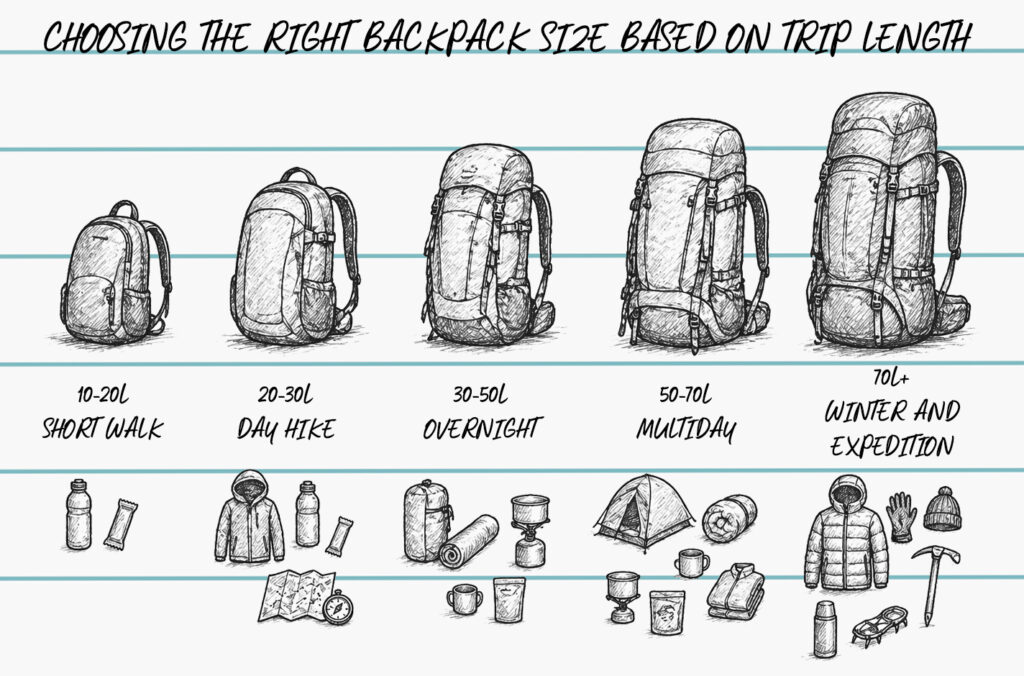
As a general guide:
| Trip type | Typical size |
| Short walk | 10–20L |
| Day hike (UK hills) | 20–30L |
| Overnight trip | 30–50L |
| Multi-day hiking | 50–70L |
| Winter / expedition trips | 70L+ |
For most UK walkers, a 20–30L backpack works well for day hikes, giving you enough room for waterproofs, spare layers, food, water and navigation kit. For overnight trips, 30–50L is usually the most useful range, depending on how compact your sleep system is and whether you’re staying on a campsite, wild camping or travelling hut-to-hut. Once you move into longer trips, especially with several days of food or bulkier gear, 50–70L becomes much more realistic.
Winter hikes and expedition-style trips often need more capacity again, simply because cold-weather kit takes up more space.
A good rule of thumb is this:
The right backpack size is the one that comfortably fits the kit you genuinely need for the trip you’re doing.
That usually leads to a pack that carries better, feels more stable on the move and makes packing much easier, especially in changeable UK conditions where layers and waterproofs are often non-negotiable.
Why backpack size matters more than most people think
Backpack size isn’t just about whether everything fits inside. It affects how comfortable you feel while walking, how naturally you move, and how prepared you are when the weather does its usual UK hillwalking surprise.
Choosing the right capacity makes a real difference over the course of a full day on the trail. Too small and you’re playing kit Tetris before you’ve even left the car park. Too big, and you end up carrying three extra layers, two spare snacks, and a “just in case” item you’ll never actually use.
If your backpack is too small
A pack that’s slightly undersized often leads to:
- Awkward packing with items strapped externally
- Poor weight distribution
- Slower access to waterproofs or spare layers
- Increased shoulder pressure from uneven loads
It can also make it harder to adapt when the weather changes, which matters on UK hill days where extra layers are often essential rather than optional.
If your backpack is too large
A larger pack isn’t automatically a problem, but extra space tends to make packing less efficient and can encourage carrying items you don’t really need.
That often leads to:
- Unnecessary weight over longer distances
- Reduced walking efficiency
- More movement inside the pack
- Extra fatigue by the end of the day
- Poor weight distribution when heavier items sit too low or too far from your back
A well-matched pack size and correctly packed load help keep your weight stable and predictable instead.
Unable to pack items in the correct weight distribution
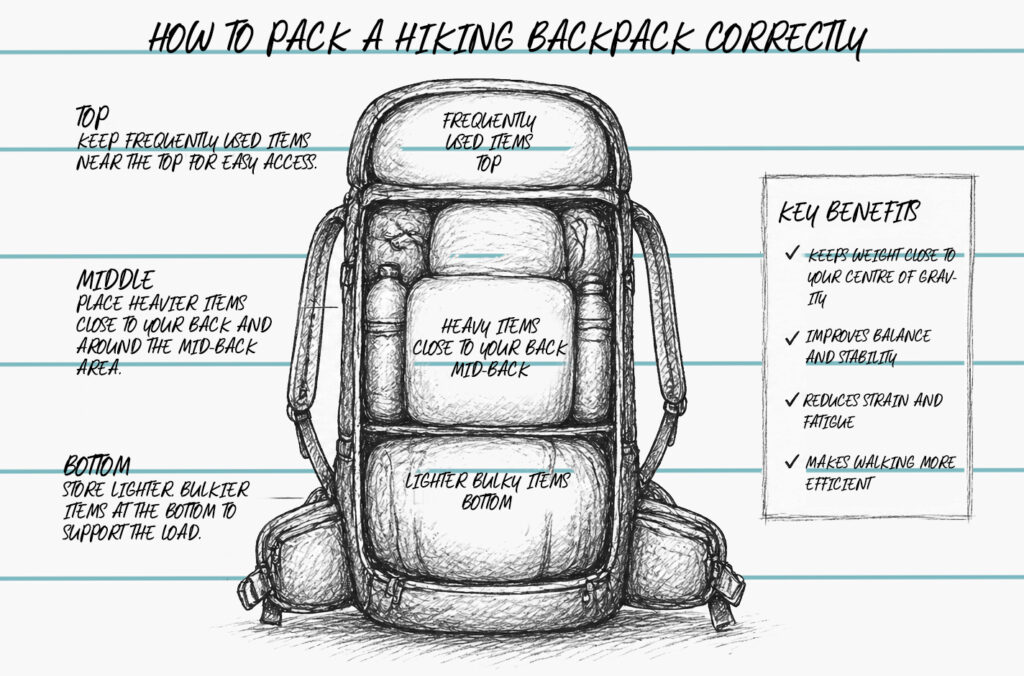
Even if the volume looks right on paper, the wrong pack size can make it difficult to position heavier gear where it should sit.
Ideally:
- Heavier items sit close to your back
- Dense gear sits mid-back height
- Lighter items go lower or further out
- Frequently used kit stays near the top or in external pockets
When a pack is too large or poorly structured, weight often drops too low or pulls away from your centre of gravity. That increases fatigue and makes walking feel less stable, especially on uneven UK terrain.
Pack shape matters as much as pack size
Capacity in litres is only part of the story. The shape and structure of a pack affect how weight sits on your body and how confidently you move over uneven terrain.
A well-sized hiking pack should:
- Keep your weight close to your centre of gravity
- Transfer load comfortably through the hip belt
- Remain stable on steep ground
- Allow natural movement through the shoulders
This becomes especially noticeable on rough descents, rocky paths and narrow ridge sections where balance matters more than people expect.
The right size improves walking comfort across typical UK conditions
Because the UK weather is changeable, most hill days involve carrying at least one extra insulating layer and a waterproof shell, even in summer. A correctly sized backpack makes it easier to carry these essentials without overloading your shoulders or affecting your balance.
When the pack size matches your trip properly, you usually notice:
- Smoother walking over a distance
- Less shoulder fatigue
- Better stability on uneven terrain
- Easier packing and organisation
- More flexibility to adjust for changing weather conditions
That’s why choosing the right backpack capacity is one of the most important early decisions when planning your hiking setup.
The three things that decide what size backpack you need
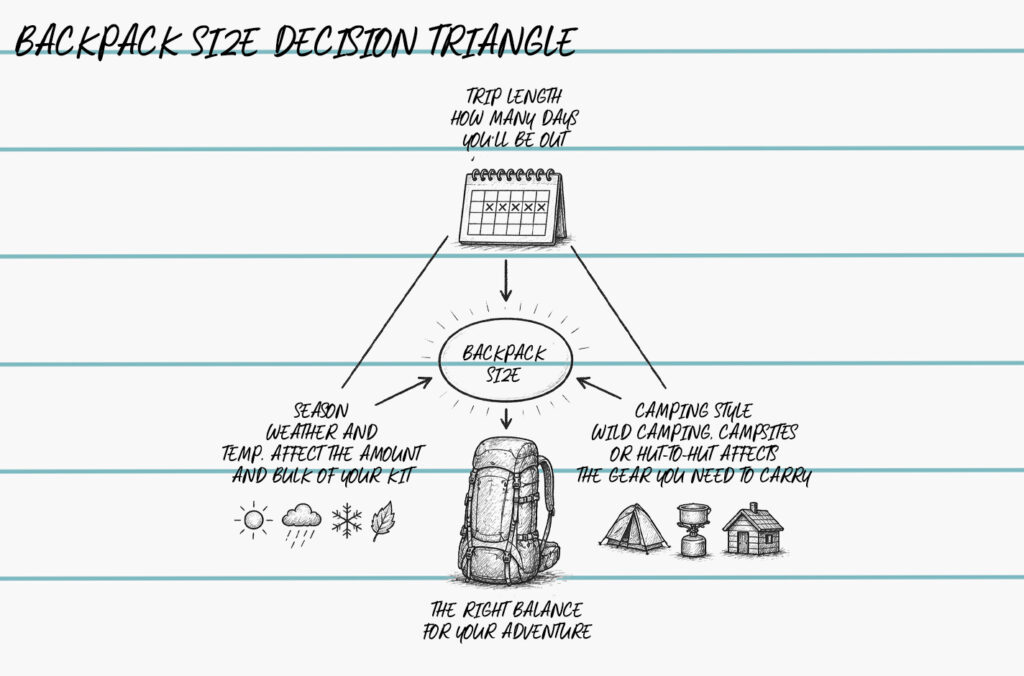
Backpack size isn’t determined by one single factor. In practice, it comes down to three main things: how long you’re going for, what season you’re walking in, and whether you’re carrying camping equipment. Once you understand these, choosing the right pack capacity becomes much more straightforward.
1. Trip length
The biggest factor when choosing backpack size is simply how long you plan to be out.
For shorter walks, you usually only need space for the basics like waterproofs, food and a spare layer or two. As trips get longer, the kit list grows surprisingly quickly, especially once shelter and a sleep system are added to the load. It only takes one overnight trip to realise how fast a small pack fills up.
A typical progression looks like this:
| Trip type | Typical pack size |
| Short local walks | 10–20L |
| Day hiking (UK hills) | 20–30L |
| Overnight hiking | 30–50L |
| Multi-day hiking trips | 50–70L |
| Week-long or remote routes | 60–75L+ |
For example, a 20–30L pack works well for most UK day hikes, while an overnight trip with camping equipment usually needs around 40–50L, depending on how compact your gear is. Longer routes such as the West Highland Way or Eryri [LP3] traverses typically move into the 50–70L range, particularly if you’re carrying several days of food.
The longer the trip, the more important pack organisation and weight distribution become, not just total capacity.
2. Season (especially important in the UK)
The season affects backpack size more than many walkers expect.
The summer kit is usually lighter and packs down smaller, so you can often get away with a lower-volume pack. In colder conditions, the extra layers, warmer gloves, bigger insulation and bulkier waterproofs quickly take up more space than you’d think.
Spring and autumn in the UK are often the trickiest. One minute it feels like early summer, the next you’re digging out your hat and wondering why you didn’t bring thicker gloves. A bit of extra pack space during these shoulder seasons can make the day much more comfortable.
Typical example:
| Trip type | Summer | Winter |
| Overnight hike | ~40L | 55–65L |
Winter trips usually require space for:
- Warmer insulation layers
- Bulkier sleeping bags
- Extra food
- Gloves, hats and spare clothing
- Additional safety equipment
Even on day hikes, winter conditions often mean moving from a 20–30L summer pack to something closer to 30–40L.
Planning your pack size around the season you hike most often is one of the simplest ways to choose the right size.
3. Your camping style
Whether you’re carrying a shelter system makes a major difference to the pack size you’ll need.
There’s a big contrast between travelling hut-to-hut with minimal equipment and carrying everything required for a wild camp.
As a rough guide:
| Style | Size needed |
| Hut-to-hut trips | 30–35L |
| Campsite overnight | 35–45L |
| Wild camping overnight | 45–55L |
Hut stays usually allow for a smaller pack because you don’t need to carry a tent, sleeping mat or stove. Campsite trips sit somewhere in the middle, while wild camping typically requires the most capacity because you’re carrying your full sleep system, shelter and food setup.
Trekitt Note: This is why two people heading out for the same overnight trip might choose completely different pack sizes depending on how they plan to camp. Even if you’re planning to stay in bothies, it’s sensible to carry a backup shelter where possible, as they can sometimes be busy or already full when you arrive.
What size backpack do you need for a day hike in the UK?
For most UK day hikes, a 20–30-litre backpack is ideal. It gives enough space to carry essential safety kit, spare layers and food without adding unnecessary bulk or weight on the move.
Even on shorter hill days, you’ll usually want room for:
- A waterproof jacket
- An insulating midlayer
- Food and water
- Map and compass
- Gloves (often needed year-round in the hills)
- A headtorch
This setup comfortably fits into a well-organised 20–30L pack and covers the majority of walking conditions across the Lake District, Eryri, the Peak District, and the Bannau Brycheiniog.
One of the key reasons this size works so well in the UK is the rapidity with which conditions can change. A walk that starts warm and calm can easily become windy, wet or cold higher up, so carrying spare layers isn’t just sensible. It’s often essential.
In practice, most walkers find that once waterproofs, insulation and navigation kit are packed properly, a pack smaller than 20L starts to feel restrictive, while anything larger than about 30L is rarely necessary for typical day routes unless you’re carrying winter gear or extra equipment for longer mountain days.
What size backpack do you need for overnight hiking trips?
For most overnight hiking trips, a 30–50 litre backpack is the typical starting point. The exact size depends mainly on whether you’re staying on a campsite, travelling with a lightweight setup, or carrying everything needed for a wild camp.
Once you add a tent, sleeping bag, mat and cooking kit, pack volume increases quickly compared with a standard day hike.
As a rough guide:
| Trip type | Typical capacity |
| Campsite overnight | 35–45L |
| Wild camping overnight | 45–55L |
Campsite overnight trips
If you’re walking to an established campsite, you can often use a slightly smaller pack because:
- Food carriers are shorter
- Facilities may be available nearby
- Equipment can sometimes be shared between people
- You may not need a full remote camping setup
A 35–45L backpack is usually enough for a typical UK overnight campsite trip with modern compact gear.
Wild camping overnight trips
Wild camping usually requires more capacity because you’re fully self-sufficient, carrying your entire shelter and sleep system.
That normally includes:
- Tent
- Sleeping bag
- Sleeping mat
- Stove and cooking kit
- Additional food
- Extra clothing layers
For most UK wild camps, a 45–55L pack provides a comfortable balance between capacity and carrying efficiency.
Lightweight overnight setups
If you’re using a compact tent, a down sleeping bag, and a minimal cooking kit, you can often stay closer to the 30–40L range, especially in summer conditions. However, this depends heavily on how compressible your equipment is and how much food you’re carrying.
In practice, most walkers planning their first overnight hiking trip in the UK find that around 40–50L works reliably across a wide range of conditions, with slightly more space helpful in colder weather when insulation layers take up extra room.
How backpack size changes for week-long hiking trips
For a week-long hiking trip, most walkers typically need a 60–75 litre backpack. At this stage, pack size is less about comfort extras and more about carrying everything required to stay self-sufficient over several days.
Exactly how much capacity you need depends on three key factors: resupply opportunities, the season, and the type of gear you’re carrying.
Resupply opportunities make the biggest difference
Access to shops, villages or campsites along your route can significantly reduce how much food you need to carry at once.
For example:
- Routes with regular resupply stops may allow packs closer to 55–65L
- Remote routes with several days between resupply points often require 65–75L
Long-distance UK trails such as the Cape Wrath Trail, or more remote sections of Scottish Highland routes, typically sit at the upper end of this range because food consumption increases quickly after the first few days.
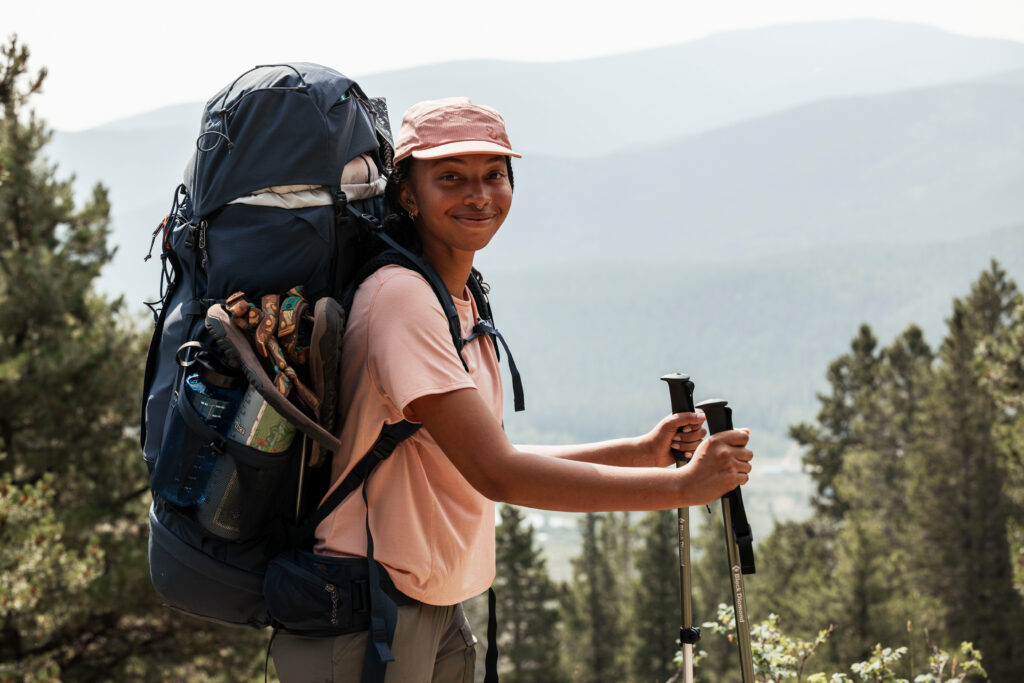
Season affects how much space your kit takes up
Cold-weather equipment is bulkier and harder to compress than summer gear. Even if the trip length stays the same, winter conditions usually increase pack size requirements.
Typical example:
- Summer week-long trip → around 60L
- Shoulder season trip → around 65–70L
- Winter conditions → often 70–75L or more
Extra insulation, warmer sleeping bags and additional spare clothing are the main reasons for this difference.
Gear type influences how efficiently everything packs
Modern lightweight equipment can noticeably reduce the pack size needed for longer trips. Compact tents, down sleeping bags and smaller cooking systems all help keep volume manageable.
On the other hand, traditional or comfort-focused setups often need additional space, especially if you’re carrying:
- Synthetic sleeping bags
- Larger tents
- Extra clothing layers
- More substantial cooking systems
Because of these differences, most walkers planning a week-long backpacking adventure in the UK find that a 60–75L backpack provides the most reliable balance between capacity, organisation and carrying comfort across a wide range of conditions.
Are women’s hiking backpacks a different size?
Women’s hiking backpacks are usually the same volume, but some models and brands can be slightly smaller. In many cases, a 30L pack is still a 30L pack. What changes most noticeably is the fit and shape of the carrying system, which is designed to sit more comfortably on a different body frame.
In other words, women’s packs are not simply smaller versions of men’s packs. They are designed to carry weight more efficiently and comfortably, though some brands occasionally reduce capacity by a litre or two to better match shorter back lengths or proportions.
The main differences are usually in fit, not capacity
Most brands offer similar litre ranges in both men’s or unisex and women’s versions. For example, a typical overnight hiking pack might be available in both standard and women ‘s-specific fits at roughly 40–50L, though the women’s version may sometimes be slightly reduced in volume.
What usually changes instead is how the pack sits on your body:
- Shorter back length to better match average torso proportions
- Narrower, more contoured shoulder straps
- Reshaped hip belt designed to sit comfortably on the hips rather than the waist
Women’s packs are commonly designed this way because shoulder width, torso length and hip shape all influence how effectively a pack transfers weight while walking.
Women’sfit often improves comfort over longer distances
A better-matched harness system can help:
- Keep your weight closer to your centre of gravity
- Reduce pressure on shoulders
- Improve load transfer through the hips
- Increase stability on uneven terrain
This becomes especially noticeable on longer hill days or multi-day trips, where carrying comfort really starts to matter
What does “ND” mean on hiking backpacks?
Some brands use labels like ND (Narrow Dimensions) to indicate women’s versions of the same pack. You’ll see this on models from brands like Lowe Alpine, where the intended use stays the same, but the back length and harness shape are adjusted for a closer fit, sometimes with a small capacity difference as well.
Similarly, ranges such as the Osprey Tempest (the women’s version of the Talon) and Rab women’s packs share the same purpose but differ in carrying shape.
The key takeaway
Backpack capacity in litres is broadly similar between men’s and women’s versions, but the most important factor is choosing a pack that matches your torso length, shoulder shape, and hip fit. That’s what makes the biggest difference to comfort on the trail.
Choosing the right backpack size for your actual kit
One of the most reliable ways to choose the correct backpack size is surprisingly simple: choose your backpack last.
Rather than guessing the volume you might need, it’s much easier and far more accurate to match your pack to the equipment you’re taking on the trip. This approach avoids buying something that’s too small to fit your setup or too large for how you hike.
At Trekitt, this is the method we usually recommend.
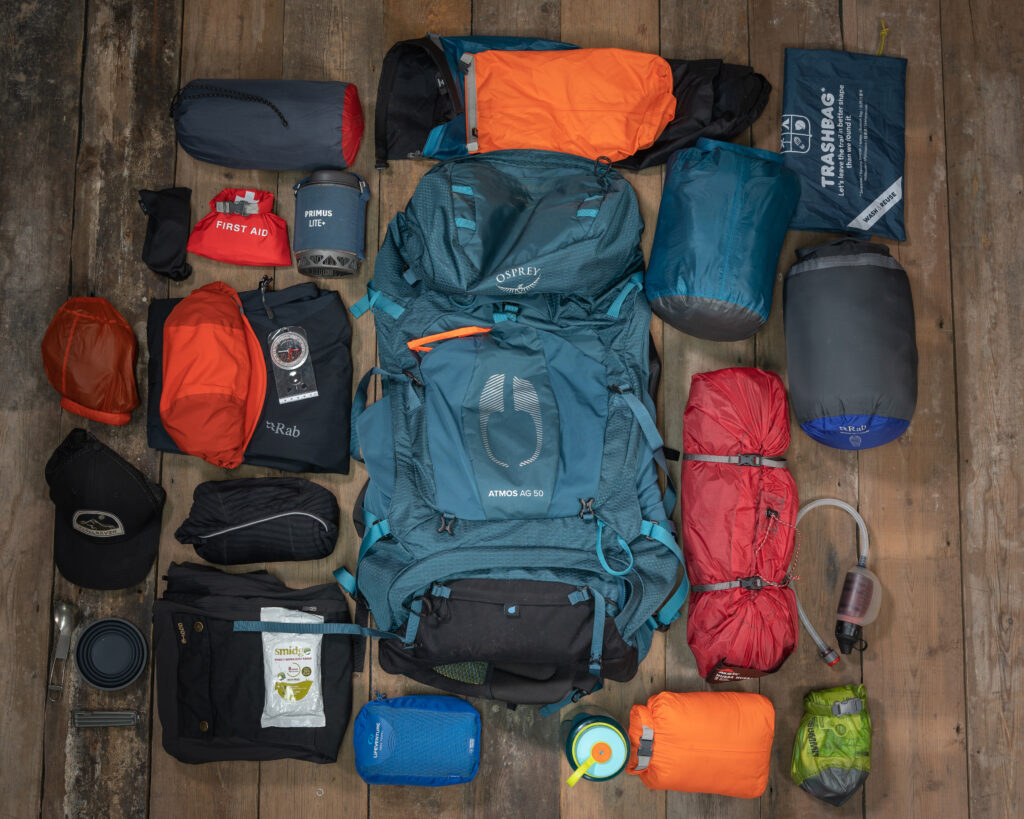
Step 1: Lay your kit out first
Start by putting everything you plan to carry on the floor:
- Clothing layers
- Waterproofs
- Shelter
- Sleep system
- Cooking kit
- Food
- Water
Seeing the full setup together makes it much easier to judge how much space you genuinely need.
Step 2: Choose your sleep system
Your sleeping bag and mat often take up more space than expected and are among the biggest factors in pack size.
For example:
- Down sleeping bags compress smaller
- Synthetic sleeping bags take up more volume
- Insulated mats pack larger than summer mats
This alone can change your pack choice by 5–10 litres.
Step 3: Choose your shelter
Your tent is usually the single largest item in your pack.
Pack size depends on:
- Whether it’s a lightweight backpacking tent
- How compressible the poles are
- Whether you’re sharing equipment with someone else
- Whether you’re carrying inner and flying together or split between two people
A compact 1–2 person backpacking tent often fits comfortably inside a 40–50L setup, while larger or more robust shelters may push you toward 50–60L.
Step 4: Estimate your food volume
Food becomes increasingly important on overnight and multi-day trips.
Ask yourself:
- How many days between resupply points?
- Are you carrying a stove?
- How compact is your cooking setup?
Even one extra day of food can noticeably increase pack volume.
Step 5: Choose your backpack last
Once everything is laid out, it becomes much easier to choose a pack that fits your equipment properly without wasted space or awkward packing compromises.
This approach usually results in:
- Better load stability
- Improved walking comfort
- Easier organisation
- More efficient packing
- Fewer surprises on your first trip out
It’s the same principle many walkers follow when preparing for longer routes or bikepacking trips: build your kit first, then choose the backpack that carries it comfortably.
Common mistakes when choosing backpack size
Choosing the right backpack size is easier once you know what influences capacity, but there are a few common mistakes that can make packs feel uncomfortable, awkward to pack, or unsuitable once you’re out on the hill. Avoiding these early issues usually leads to a much better experience on your first trip.
Choosing a pack that’s bigger than you need
It’s natural to want a backpack that works across lots of different trips, but extra space doesn’t always make things easier. Larger packs can make packing less efficient and allow weight to move around more while walking.
Matching pack size to your typical trip length usually results in:
- Better stability on uneven ground
- Improved walking comfort
- Easier organisation
- Less unnecessary weight over distance
Many walkers find that having one pack for day hikes and another for overnight or multi-day trips works better than trying to cover everything with a single large pack.
Copying ultralight packing lists without matching the gear
Ultralight setups often look appealing online, but they usually rely on very specific equipment choices.
For example:
- Compact shelters
- Down sleeping bags
- Minimal cooking systems
- Limited spare clothing
If your equipment isn’t designed around that approach, choosing a smaller pack based on an ultralight list can quickly lead to packing problems.
It’s always more reliable to choose a backpack that matches your own kit, rather than someone else’s packing strategy.
Not accounting for the winter kit
Cold-weather gear takes up more space than many people expect. Even if your trip length stays the same, winter conditions often mean needing a larger pack.
Typical additions include:
- Thicker insulation layers
- Bulkier sleeping bags
- Extra gloves and spare clothing
- Additional food
- Safety equipment
Planning around the season you hike most often helps avoid needing to upgrade your pack later.
Choosing the backpack before choosing your gear
This is probably the most common mistake.
Backpack size depends heavily on:
- Shelter
- Sleeping bag
- Sleeping mat
- Cooking setup
- Food carry
Choosing these first makes it much easier to select the right capacity afterwards.
Not testing how the pack fits when loaded
Pack fit matters just as much as pack volume. A backpack that looks right on paper can feel very different once it’s carrying real weight.
Before committing to a pack, it’s worth checking:
- Back length adjustment
- Hip belt position
- Shoulder strap comfort
- Load stability when walking
A properly fitted pack should transfer most of the weight to your hips rather than your shoulders, which makes a noticeable difference over longer distances.
Recommended backpack sizes for UK trail walking
Once you match the pack size to the trip length and season, it becomes much easier to choose the right backpack category for typical UK routes. Below is a practical guide based on the kinds of terrain and trips most walkers plan across the UK.
Day hiking packs (20–30L)
A 20–30L backpack is ideal for most day walks across areas like the Peak District, Lake District and South Downs, where you’ll usually carry waterproofs, spare layers, food, navigation kit and a few safety essentials.
This size range keeps weight stable and manageable while still leaving space for extra clothing when conditions change higher up or later in the day, something that’s particularly relevant on UK hill routes.
Popular examples in this category include:
- Osprey Talon – lightweight, close-fitting and excellent for active hill days
- Rab Aeon – stable and streamlined for faster-paced walking
- Lowe Alpine AirZone Active – comfortable with good ventilation for warmer conditions
These packs suit everything from shorter ridge walks to full-day mountain routes where efficiency and comfort matter most.
Overnight packs (30–50L)
For overnight trips, especially wild camps, short multi-day outings or lightweight camping setups, a 30–50L pack usually provides the right balance between capacity and carrying comfort.
At this size, there’s typically room for:
- A compact tent
- Sleeping bag
- Sleeping mat
- Cooking kit
- Spare clothing
- Food for one or two days
Well-suited packs in this range include:
- Rab Muon 40 – lightweight and efficient for minimalist overnight trips
- Osprey Exos 38 – excellent for summer wild camps and longer hill days with extra kit
This category works especially well for classic UK overnight routes where you’re travelling self-supported but not carrying extended food supplies.
Multi-day packs (50–70L)
For longer journeys across remote terrain or long-distance UK trails, a 50–70L backpack becomes the most practical option. These trips usually involve carrying several days of food along with a full shelter and sleep system.
Typical examples include:
- Extended sections of the West Highland Way
- Remote Scottish routes
- Multi-day crossings in Snowdonia
- Longer wild camping itineraries in the Lake District
Reliable packs in this category include:
- Osprey Atmos AG – excellent load support for longer distances
- Rab Muon 50 – a lighter option for efficient multi-day setups
At this stage, pack structure and comfort become just as important as capacity. A well-fitted 60L pack will usually feel noticeably better over several days than a larger pack that isn’t properly matched to your setup.
Final Word
Choosing the right backpack size makes your day on the hill noticeably more comfortable, but getting the fit right matters just as much as the litres on the label. Even the best pack in the world won’t feel great if it’s sitting on your shoulders like an overenthusiastic passenger rather than working properly with your body.
If you’re not completely sure how a pack should sit, how tight the hipbelt needs to be, or what those mysterious load-lifters do, it’s well worth taking a few minutes to check the setup properly. A small adjustment can make a surprisingly big difference over a long walk.
We’ve put together a simple step-by-step guide on how to fit your hiking backpack correctly, but if you’re still unsure, the Trekitt team are always happy to help. You can drop into our Hereford shop for an in-person fit, or speak with our Customer Service team for advice before your next trip.
It’s much nicer to get everything dialled in now than halfway up a hill, wondering why your shoulders are doing all the work
FAQ
For most UK day hikes, a 20–30 litre backpack is ideal. This provides enough space for waterproof clothing, spare layers, food, water, navigation tools and a headtorch. In winter or on longer mountain days, some walkers prefer 30–40L to allow room for bulkier insulation and extra safety kit.
Yes, a 40L backpack is usually enough for overnight hiking, especially in summer or when using compact camping equipment.
A 40L pack typically works well if:
Your sleeping bag compresses well
Your tent is lightweight
You’re carrying food for one night only
Conditions are mild
For winter trips or less compact setups, something closer to 45–55L is often more comfortable.
Most multi-day hiking trips in the UK require a 50–70 litre backpack.
This allows space for:
Tent
Sleeping bag
Sleeping mat
Cooking equipment
Spare clothing
Several days of food
Shorter summer multi-day routes sometimes work with slightly less capacity, but 50–70L is the most reliable range for typical UK conditions.
A week-long hiking trip usually requires a 60–75 litre backpack, depending on how often you can resupply along the route and what season you’re walking in.
Trips with regular access to shops or campsites may allow slightly smaller packs, while remote routes or colder conditions usually sit toward the upper end of this range.
It’s usually better to choose a backpack that matches the trips you plan to do most often.
Larger packs can be useful for longer routes, but for regular day hikes or overnight trips, they can make packing less efficient and encourage carrying extra weight. Choosing the right size for your typical setup usually results in better comfort and stability on the move.
Leave a Reply