Trekitt’s Ultimate Guide To Crampons (Updated for Winter 2025–2026)
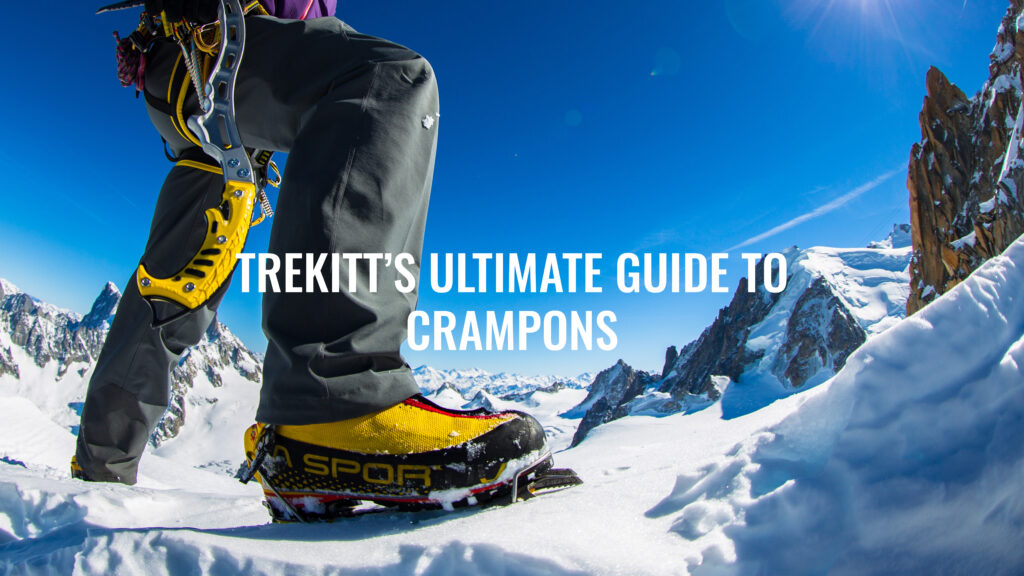
Planning winter adventures? This ultimate guide to crampons covers everything you need to know—from types and ratings to pairing them with the right boots for safe, effective traction on snow and ice.
Updated for Winter 2025–2026: This season’s crampon technology hasn’t changed drastically, but several new lightweight models and adaptable hybrid systems are making waves. We’ve refreshed this guide with the latest insights to help you choose the right crampons and compatible boots for your upcoming winter adventures.
In SHORT…
-
Understand crampon types and uses: Learn the key differences between strap-on, semi-automatic, automatic crampons and microspikes, and how to match them to activities like hiking, mountaineering, or ice climbing.
-
Match boots and crampons correctly: Explore the essential B (boot) and C (crampon) rating systems to find safe, compatible gear combinations for everything from winter walking to technical climbs.
-
Know expert tips for safer adventures: Discover why timing matters when fitting crampons, what anti-balling plates do, and how adaptable crampon systems are changing the game for modern mountaineers.
Short on time? Check your crampon compatibility
The right crampons start with the right boots. Use the table below to quickly check which crampon rating works with your footwear. Click the C1, C2 or C3 links to explore and shop crampons in that category. If you’re unsure what the different boot and crampon ratings mean, don’t worry, we explain each rating and how the system works in more detail further down this guide.
| Boot Type | Compatible Crampons | Best For |
| B0 Boots | Not generally suitable for traditional crampons | Everyday hiking and walking on non-technical terrain |
| B1 Boots | C1 crampons | Winter walking and less technical winter routes |
| B2 Boots | C1 or C2 crampons | Winter hiking, mountaineering and more technical terrain |
| B3 Boots | C1, C2 or C3 crampons | Technical mountaineering, ice climbing and demanding winter routes |
Please note: B/C ratings are a general compatibility guide. Always check that your chosen crampons fit your specific boots correctly and follow the manufacturer’s compatibility guidance before heading out.
This article is part of our Winter Gear and Apparel Guide, where you’ll find expert layering advice, technical gear deep dives and practical cold-weather tips.
Crampons. Where to even begin? Crampons are an essential piece of winter kit for those who enjoy adventuring on ice and snow, whether climbing up an icy gulley or trekking across a snow-covered peak. But it’s important to wear the correct crampons and pair them with the right boots.
Why? Well, in severe situations, it could be a matter of catastrophe, but generally, it’ll help prevent accidents and likely contribute to how much enjoyment you get from your adventure.
Let’s start by going back to basics.
What Are Crampons, and What Are They Used For?
Crampons are a set of metal spikes that you attach to your boots to improve mobility and traction on snow and ice. They’re often made from steel or aluminum and have a varying number of spikes on the bottom, tailored to different uses.
People often use crampons for hiking and trekking in freezing conditions, crossing glaciers, ski touring, ice climbing and winter mountaineering. They come in various weights and materials, each with their own pros and cons.
Steel vs aluminium crampons
Steel is preferred, due to its strength, although this option does weigh more. Aluminum is becoming more common, but generally isn’t suited to sparse UK conditions, where you’re more likely to kick a rock than a snowball, as this is where aluminum has the potential to break – not good for safety, or your bank balance!

The Anatomy Of A Crampon
Crampons have a front section and a heel section, joined by a bar in the middle. The more flexible the bar, the better suited to walking it is. The stiffer the bar, the better suited to climbing it is. These bars have holes which allow adjustability for accommodating different sized boots.
They also have spikes, and right underneath your toe are the front points of the crampon. Short horizontal points are better suited to walking, whilst long horizontal points are better suited to mountaineering and sharp vertical points to climbing. It’s also worth noting that the more spikes on the front section, the better suited to technical mountaineering they are.
Anti-balling plates
Underneath you’ll see plastic plates called anti-balling plates. Anti-balling plates aim to stop snow from freezing to the exposed metal on the underside of the crampons. Otherwise, without these plates, snowballs could potentially under your feet, rendering the points of the crampons useless. These plates also aim to stop snow from becoming compacted in-between the crampon and the boot, which has the potential to knock the crampon off altogether.
On the top of the crampons, you may notice differing methods for attaching them to your boots.
Strap-on crampons
Strap-on crampons feature plastic baskets at the heel and toe, joined with a strap to hold them in place. These are the most versatile, but least secure, providing a good option for walkers, although not the durability required for climbing and mountaineering.
Semi-automatic crampons
Semi-automatic crampons have a plastic toe basket and a heel clamp, with straps between them to hold them in place. This design gives the best all-round performance and offers security, as well as adjustability, when used with compatible boots.
Automatic crampons
Automatic crampons feature metal toe bails and heel clamps. They offer the most durable and secure fit when used with the right footwear.
Microspikes
Microspikes, or pavement crampons, are becoming increasingly popular. They’re great when used for their intended purpose – to gain traction over flatter, icy ground. However, they can be less effective on steeper paths, or even on slightly angled side slopes, as the only thing attaching them to your boots is some stretchy elastomer. This is because the flexibility of this elastomer makes it easy for your boot to slip out of the crampon.
Microspikes also lack the anti-balling functionality underneath, meaning in sticky snow, you spend more time knocking the snowballs off the bottom than you do walking.
Rating Systems
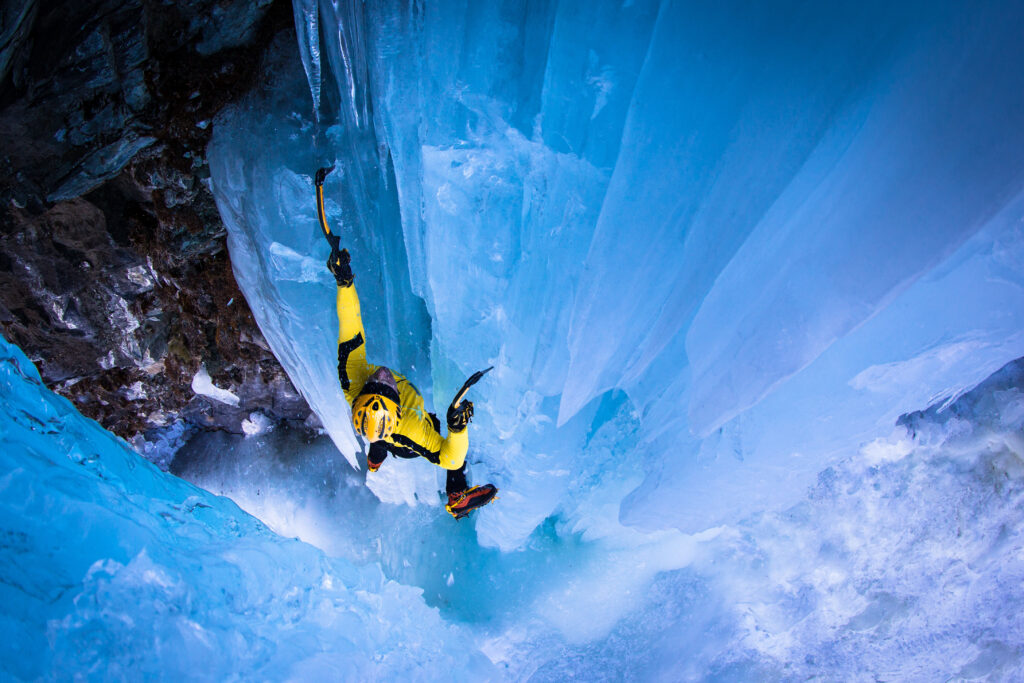
Neither crampons nor boots have a common rating system, either for stiffness or intended use, particularly across brands. However, labels often design boots with a particular use in mind. The requirements for a winter walker’s boot and crampon combination are very different to the needs of either a Ski Tourer or Ice Climber, for example.
To help differentiate between the sort of rigours that you’ll be putting the boots and crampons under, you’ll often hear of a system that uses B-ratings for boots and C-ratings for crampons. These letters are followed by either 1,2 or 3, denoting the stiffness of the product, 1 being more flexible, and 3 being less flexible. Each rating allows you to decipher which crampons and boots are suitable for certain activities, and which crampons need pairing with which boots.
In terms of ratings, it’s worth starting with your footwear, as your boots will indicate what crampons are suitable for use with them.
Boot Ratings
B1 boots
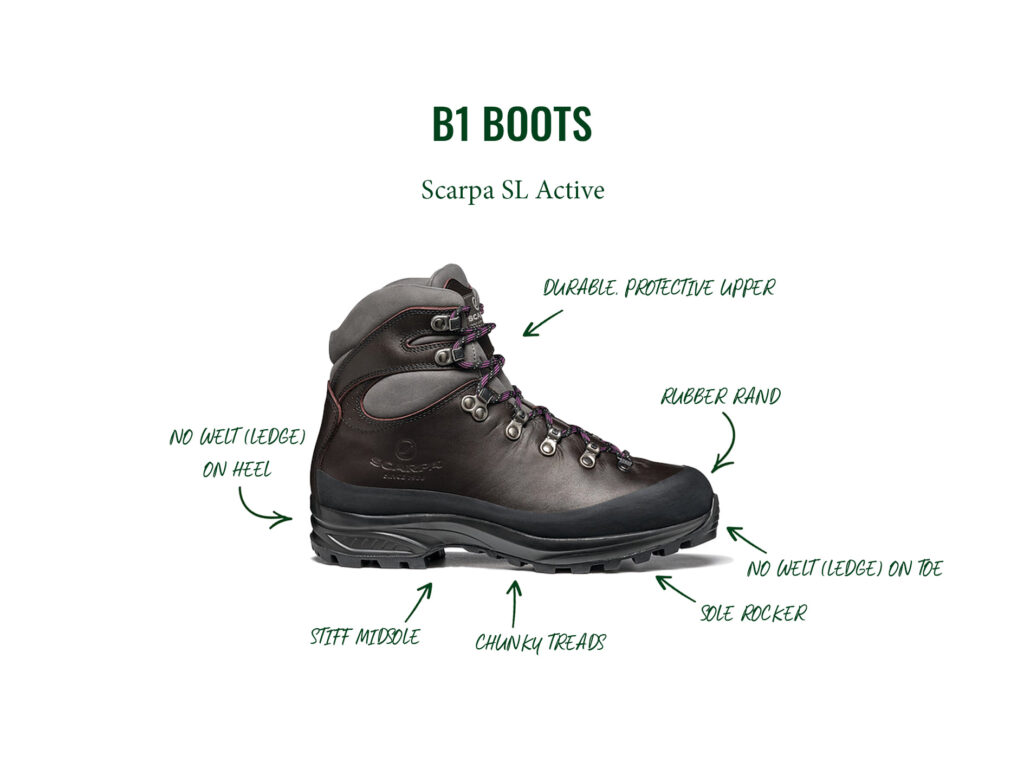
These boots are designed for four-season use and can be worn for hiking, trekking, scrambling or less technical winter walks. B1 boots have a stiffer midsole and chunkier tread on the outsole.
You’ll often find a more walking-orientated tread pattern on a B1 boot, when compared to some of its more winter-mountaineering-focused cousins. They also have a good amount of ‘rocker’ to allow a natural gait when walking. Manufacturers often combine these features with leather or fabric uppers that provide ample protection and durability. Walking-focused models sometimes include insulation, too.
Finding a TPU heel ledge for additional, secure crampon compatibility is becoming more common, especially in climbing-focused models. You should wear B1-rated boots with C1 crampons. This pairing will work perfectly for most UK winter fell walks and gentle adventures in the snow.
B2 boots
The midsole and upper of B2 boots are stiff and supportive, giving you ample protection in rocky or uneven terrain. However, they also have just enough flexibility to allow you to walk. B2 boots generally fall into two categories – faster and lighter or bigger and chunkier.
The faster and lighter ones have a flatter, more climbing-focused sole, aiming for activities such as summer scrambling over rocky climbing terrain.
With the ability to attach a mountaineering crampon for winter activities, the trade-off here is warmth. Chunkier and thicker boots work better for more winter-based activities. They still have a climbing sole, this time with a slight rocker, insulation and tougher uppers. You’ll also (almost) unanimously have a heel ledge that helps crampons fit securely.
These boots usually need pairing with C2 crampons to create an ideal setup for winter Munro-bagging and low to mid-grade climbing in snow and ice. A B2/C2 combination would also work well for summer Alpinism.
With the ability to attach a mountaineering crampon for winter activities, the trade-off here is warmth. Chunkier and thicker boots will be aimed for more for winter-based activities. They still have a climbing sole, this time with a slight rocker, insulation and tougher uppers. You’ll also (almost) unanimously have a heel ledge that helps crampons fit securely.
These boots are to be paired with C2 crampons, which would be ideal for winter Munro-bagging and low to mid-grade climbing in snow and ice. A B2/C2 combination would also work well for summer Alpinism.

B3 boots
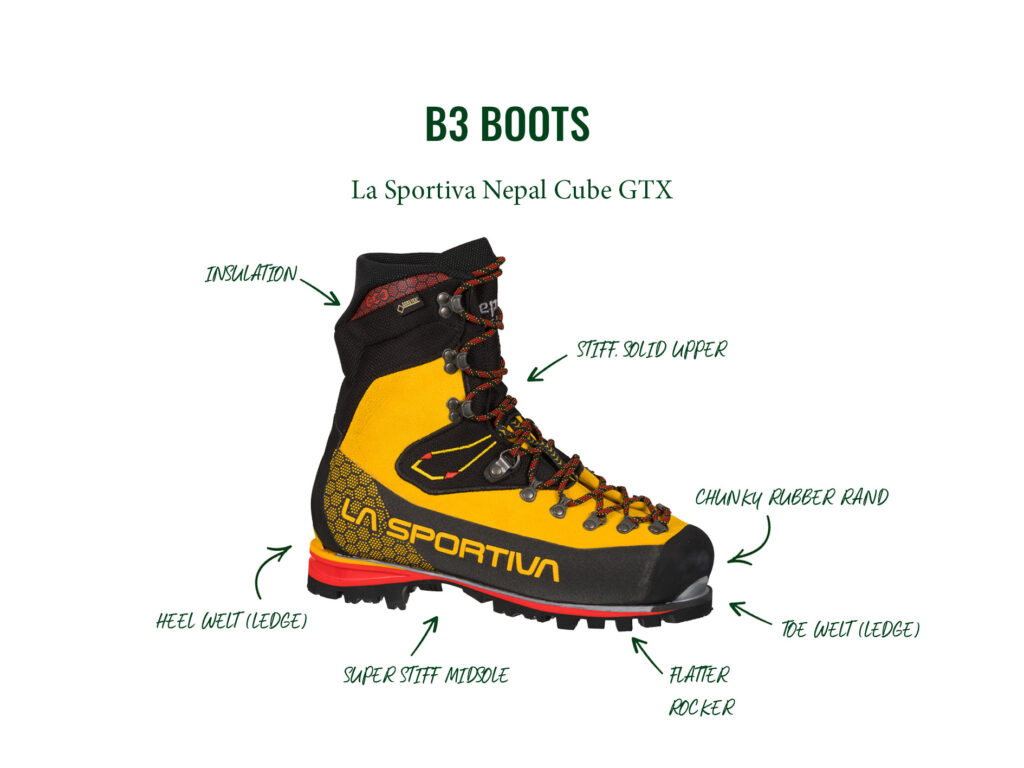
B3 boots are the stiffest boots you can buy. They provide lateral and medial support for different actions and movements on technical terrain. B3-rated footwear best suits activities like advanced mountaineering, mixed climbing, and ice climbing. This rating also includes models with extra insulation for high-altitude missions.
Common features include heel and toe welts (ledges) that allow C3 crampons to fix onto the boot. These features help you to visibly identify a B3 boot compared to B2s, which only have the rear welt (ledge).
Next up are the Crampons. Again, we’ve broken down each rating to give you a clearer idea of this system.
Crampon Ratings
C1 crampons
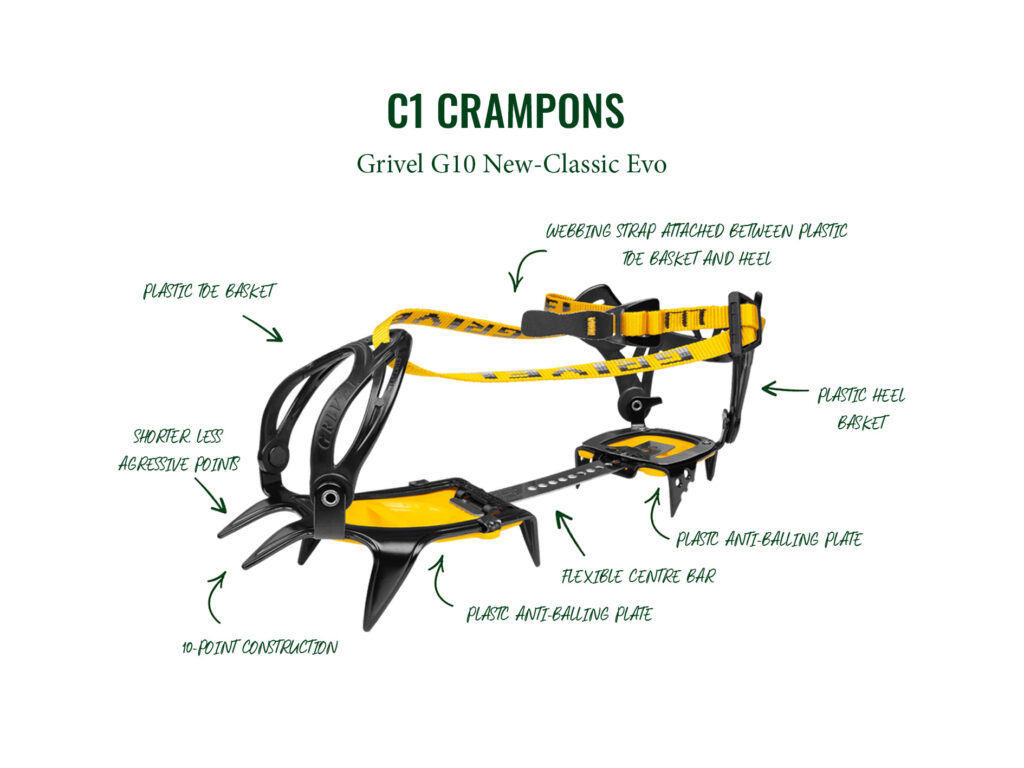
C1 crampons are primarily used for walking, as the shorter, less aggressive points and more flexible binding systems do not lend themselves to climbing. Whether hiking Scottish Munros in Winter or trekking across Glaciers, they give you ample grip in snow and ice. These crampons usually have 10 points and a flexible bar in the middle to accommodate stiffer hiking boots, which still tend to be a little softer than full-on mountaineering boots. You’ll also notice a more flexible heel, toe baskets and connected straps that you can use to attach them.
C2 crampons
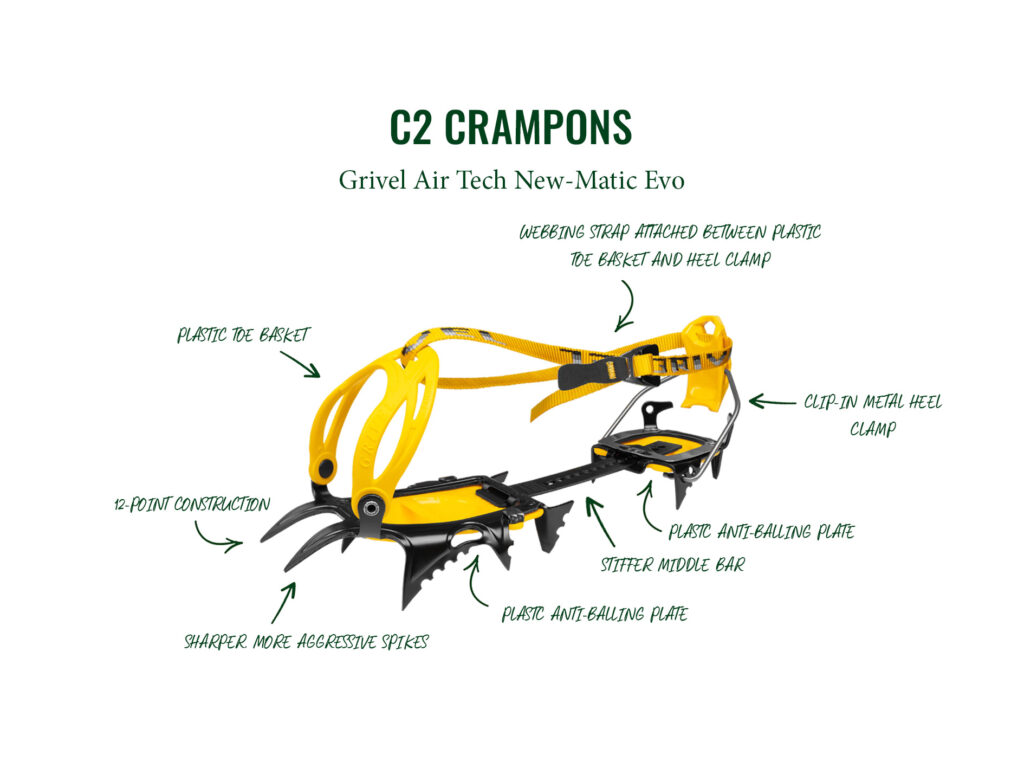
C2 crampons usually have 12 spikes, which are more aggressive, to add extra traction in snow and ice. They’re designed for walking on more technical, icy terrain and climbing less advanced routes during the winter. Another noticeable visual difference on C2 crampons is that, unlike C1 crampons, they have specific clips on the rear. This clip attaches to the rear welt of most B2 boots, and is paired with a flexible, plastic toe basket and straps in between. The crampons will also flex less through the middle bar, lending themselves well to stiffer mountaineering boots.
C3 crampons
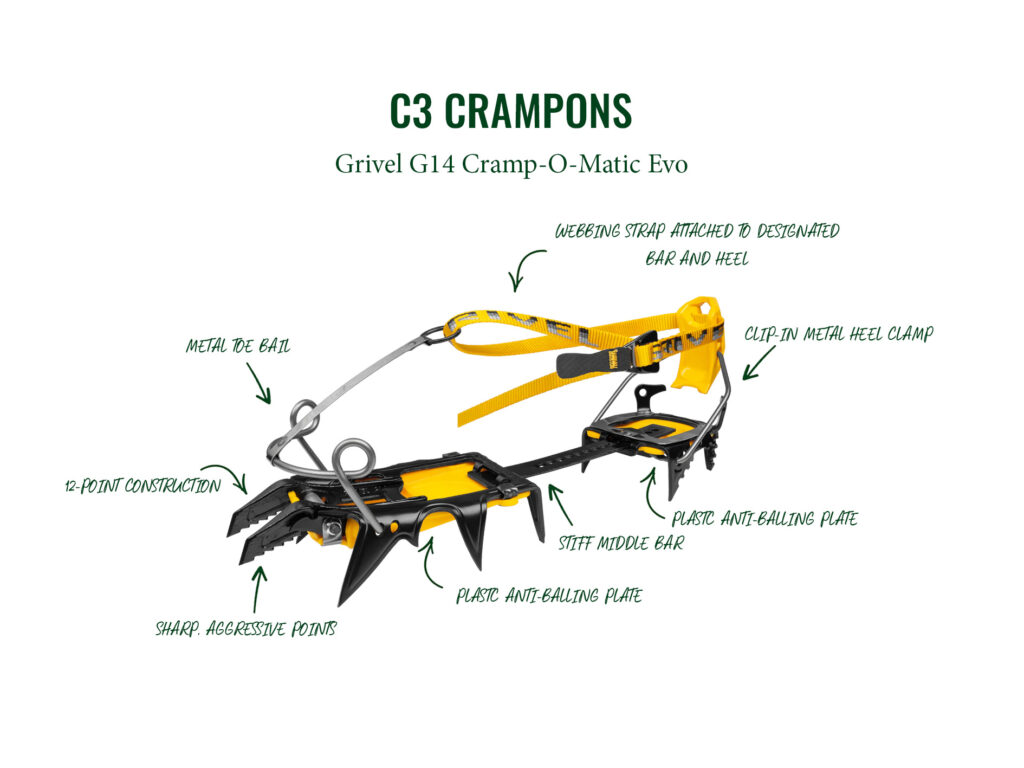
A C3 crampon will take all the details from C2 crampons up a notch. The rear heel clip remains, but now you have a metal toe bail, rather than the plastic basket. You’ll notice B3 boots have welts on the front and rear to accommodate this, overall creating a secure fit on a stiff boot. These metal toe bails on the front provide more durability against solid ice and rock, which is safer than plastic for more technical ascents. Some crampons also allow you to reduce the number of points on the front to just one, for more precision on delicate terrain or climbing narrow cracks. C3 crampons are generally used for technical ice climbing.
Adaptation systems
Some crampons are now being developed with ‘adaptation systems’ that allow you to transform a C2 crampon into a C3 crampon by, for example, changing the binding system. Some even have the ability to fit a different front section, one that is more aggressive, as your interests progress. This gives the user more versatility on different adventures and terrains, without spending double the price on multiple pairs. Keep an eye out for these coming into stock here shortly!
Crampons with cords?
You may also see crampons with a cord in the middle instead of a bar. A cord? Sounds a little ominous? This shouldn’t be a cause for concern; the cable is usually made with Dyneema, which is incredibly strong – so strong that it’s trademarked as the world’s strongest fibre. However, these lightweight crampons are only suited for use with rigid ski boots, for more technical levels of ski touring. Their lighter-weight construction makes them more packable and suited to consolidated snow, but not rocks and ice. These stiffer ski boots are needed to counterbalance the crampons’ flexibility – the last thing you want is your crampons popping from your boots mid-adventure!
Crampon Tips
A quick tip we’d offer to any crampon newbies is to be proactive. It can be easy to wait until you need them to wear them, but this can prove more difficult or even become dangerous if you get stuck on a snowy or icy patch with nowhere to rest and put them on. If you see a lot of snow or ice on the route ahead, put your crampons on before you reach that point. It’ll save you a lot of faff or stress and generally gives you the upper hand regarding safety.
🧭 What’s New for Winter 2026/2027
Crampon development for winter 2026/27 is all about getting more performance from less. Lightweight construction continues to make its way into technical mountaineering models, while modular components give climbers more freedom to adapt their setup to different boots, terrain, and objectives.
Lightweight Doesn’t Just Mean Aluminium Anymore
Reducing weight once meant making an obvious compromise between lightweight aluminium crampons and tougher steel designs. The latest generation is beginning to blur that line.
Grivel’s LT construction uses optimised material thickness to reduce unnecessary weight while retaining the durability required for mountain use. You’ll see the LT name throughout the range, from the G10 LT NC EVO and GX LT T-Matic EVO to more technical models such as the G12 LT, G15 LT and G20+ LT.
For mountaineers, that means more choice when trying to cut weight without automatically moving away from steel construction.
Modular Crampons Get Much More Interesting
Modularity remains one of the biggest developments in modern crampon design, but for 2026/27, it’s becoming much more than simply choosing a different binding.
Grivel’s latest system uses interchangeable components across several LT models, allowing compatible front and rear sections and binding components to create different configurations. It’s a useful development for mountaineers whose footwear or objectives change between trips.
The G15 LT takes this idea even further. Its modular front-point system can be configured with mono or dual Katana points, or Alpine front points, allowing the crampon to be adapted for different terrain and climbing styles.
Technical Crampons Become Lighter and More Adaptable
Weight saving isn’t reserved for general mountaineering either. Some of the most interesting developments this winter are appearing at the technical end of the range.
The new Grivel G15 LT Dual combines a lightweight construction with modular front points for technical mountaineering, ice climbing and mixed climbing. Its front points can be configured to suit the terrain and climbing style, while ballistic steel is used, where precision and durability matter most.
For even more specialised climbing, the Grivel G20+ LT COM EVO brings the LT approach to a mono-point crampon designed for ice, mixed, and dry tooling. Its interchangeable front-point system provides another example of how technical crampons are moving towards adaptable setups rather than remaining fixed.
Crampons Trekitt New Arrivals for AW26/27
Our AW26/27 range reflects this shift towards lighter, more adaptable mountain equipment. Here are a few models to look out for.
Grivel G15 LT Dual 12-Point Modular Steel Crampon
One of the most interesting new additions to the range, the G15 LT Dual is designed for technical mountaineering, ice and mixed climbing. Its standout feature is the modular front-point system, which allows climbers to configure the front for different terrain and climbing styles.
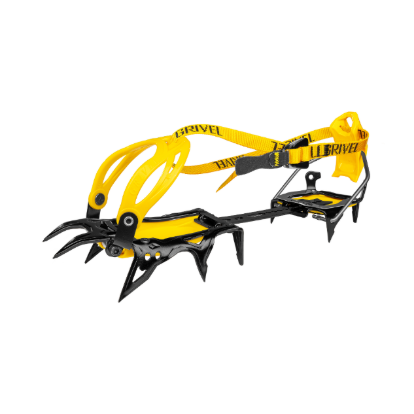
Grivel G20+ LT COM EVO Mono-Point Steel Crampon
Built for more technical objectives, the G20+ LT uses a mono-point setup for precision on ice and mixed terrain. An interchangeable front-point system means the crampon can be configured with different compatible points, combining specialist climbing performance with greater adaptability.
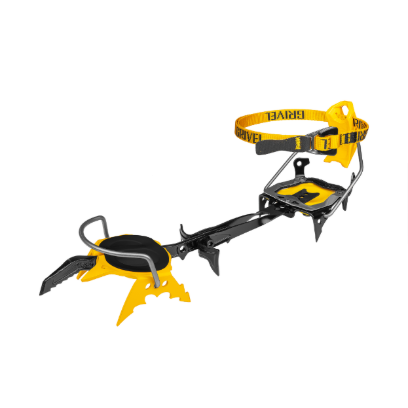
Grivel Air Tech LT Dual 12-Point Steel Crampon
The Air Tech LT Dual brings lightweight steel construction to more traditional mountaineering. Its 12-point design is intended for classical mountaineering and glacier travel, making it a good example of how weight-saving LT construction is spreading beyond highly specialised climbing crampons.
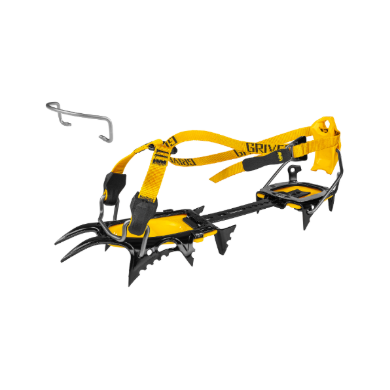
Grivel Air Tech Hybrid Dual 12-Point Crampon
Their hybrid construction remains another useful way of balancing durability and weight. The Air Tech Hybrid Dual 12 sits within Grivel’s increasingly interchangeable crampon system, giving mountaineers another option for versatile mountain performance without adding unnecessary weight.
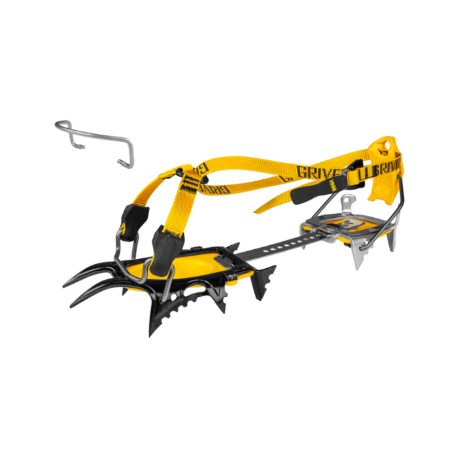
Summary
So, in a nutshell, the rating systems make it pretty easy to correspond your crampons to your activity and your boots. As long as you match the numbers, you’re pretty much good to go.
We stock a large variety of crampons, spikes and accessories here at Trekitt, including renowned brands like Petzl, Grivel, Nortec, Kahtoola and Black Diamond. You can shop our entire range of crampons by clicking here.
Looking for some new boots to match? We stock plenty of those, too! Check them out here.
If you want to dive a bit deeper into how to match your winter boots with your crampons — especially for typical UK hill conditions — check out our blog Choosing the Right Winter Boots and Crampons for UK Hills. It’s a super handy read and pairs really nicely with everything we’ve covered here.
If you have any questions, or need some further advice before you purchase, you can visit us in-store at our Hereford Service Centre, or speak with our friendly customer service team via telephone (01432 263 335) or email ([email protected]).
FAQ
For UK winter walks or general mountaineering, C1 or C2 crampons are ideal. C1 models suit stiff walking boots (B1-rated), while C2s pair with more supportive B2 boots for steeper or icier routes.
Not quite. Crampons need to match your boot’s stiffness rating — that’s where the B (boot) and C (crampon) compatibility system comes in. A mismatch can cause crampons to pop off or flex incorrectly, so always double-check before heading out.
Yes, if you’re mixing different activities. Modern modular systems (like Petzl’s Alpen Adapt) let you change bindings or front sections, meaning one set can handle hiking, alpine routes, and ice climbing — saving weight and cost in the long run.
Absolutely. They prevent snow from clogging under your feet, which can otherwise make crampons useless. Most modern models now include improved plates as standard.
Models like the Blue Ice Harfang or Petzl Irvis Hybrid utilise Dyneema connectors and minimalist frames to minimise weight — perfect for ski touring or fast-and-light ascents.
Rinse them after use, dry thoroughly, and lightly oil the metal points to prevent rust. Store them in a crampon bag or wrap to protect other gear in your pack.
Strap-on: Fit most boots but offer less precision.
Semi-automatic: Use a heel clip and toe basket — a solid all-rounder.
Automatic: Rigid, technical fit for fully stiff B3 boots used in climbing.
In:

Leave a Reply